

LeetCode 题解工作台
并行课程 III
给你一个整数 n ,表示有 n 节课,课程编号从 1 到 n 。同时给你一个二维整数数组 relations ,其中 relations[j] = [prevCourse j , nextCourse j ] ,表示课程 prevCourse j 必须在课程 nextCourse j 之前 完成(先…
4
题型
5
代码语言
3
相关题
当前训练重点
困难 · 动态·规划
答案摘要
我们首先根据给定的先修课程关系,构建出一个有向无环图,对该图进行拓扑排序,然后根据拓扑排序的结果,使用动态规划求出完成所有课程所需要的最少时间。 我们定义以下几个数据结构或变量:


Interview AiBoxInterview AiBox 实时 AI 助手,陪你讲清 动态·规划 题型思路
题目描述
给你一个整数 n ,表示有 n 节课,课程编号从 1 到 n 。同时给你一个二维整数数组 relations ,其中 relations[j] = [prevCoursej, nextCoursej] ,表示课程 prevCoursej 必须在课程 nextCoursej 之前 完成(先修课的关系)。同时给你一个下标从 0 开始的整数数组 time ,其中 time[i] 表示完成第 (i+1) 门课程需要花费的 月份 数。
请你根据以下规则算出完成所有课程所需要的 最少 月份数:
- 如果一门课的所有先修课都已经完成,你可以在 任意 时间开始这门课程。
- 你可以 同时 上 任意门课程 。
请你返回完成所有课程所需要的 最少 月份数。
注意:测试数据保证一定可以完成所有课程(也就是先修课的关系构成一个有向无环图)。
示例 1:
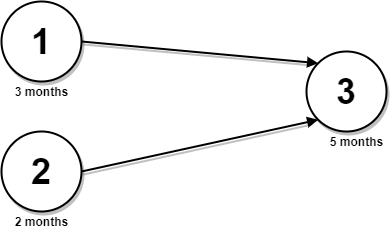
输入:n = 3, relations = [[1,3],[2,3]], time = [3,2,5]
输出:8
解释:上图展示了输入数据所表示的先修关系图,以及完成每门课程需要花费的时间。
你可以在月份 0 同时开始课程 1 和 2 。
课程 1 花费 3 个月,课程 2 花费 2 个月。
所以,最早开始课程 3 的时间是月份 3 ,完成所有课程所需时间为 3 + 5 = 8 个月。
示例 2:
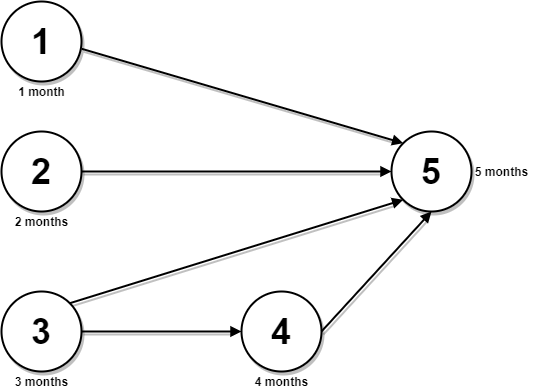
输入:n = 5, relations = [[1,5],[2,5],[3,5],[3,4],[4,5]], time = [1,2,3,4,5]
输出:12
解释:上图展示了输入数据所表示的先修关系图,以及完成每门课程需要花费的时间。
你可以在月份 0 同时开始课程 1 ,2 和 3 。
在月份 1,2 和 3 分别完成这三门课程。
课程 4 需在课程 3 之后开始,也就是 3 个月后。课程 4 在 3 + 4 = 7 月完成。
课程 5 需在课程 1,2,3 和 4 之后开始,也就是在 max(1,2,3,7) = 7 月开始。
所以完成所有课程所需的最少时间为 7 + 5 = 12 个月。
提示:
1 <= n <= 5 * 1040 <= relations.length <= min(n * (n - 1) / 2, 5 * 104)relations[j].length == 21 <= prevCoursej, nextCoursej <= nprevCoursej != nextCoursej- 所有的先修课程对
[prevCoursej, nextCoursej]都是 互不相同 的。 time.length == n1 <= time[i] <= 104- 先修课程图是一个有向无环图。
解题思路
方法一:拓扑排序 + 动态规划
我们首先根据给定的先修课程关系,构建出一个有向无环图,对该图进行拓扑排序,然后根据拓扑排序的结果,使用动态规划求出完成所有课程所需要的最少时间。
我们定义以下几个数据结构或变量:
- 邻接表 存储有向无环图,同时使用一个数组 存储每个节点的入度;
- 队列 存储所有入度为 的节点;
- 数组 存储每个节点的最早完成时间,初始时 ;
- 变量 记录最终的答案,初始时 ;
当 非空时,依次取出队首节点 ,遍历 中的每个节点 ,更新 ,同时更新 ,并将 的入度减 ,如果此时 的入度为 ,则将 加入队列 中;
最终返回 。
时间复杂度 ,空间复杂度 。其中 是数组 的长度。
class Solution:
    def minimumTime(self, n: int, relations: List[List[int]], time: List[int]) -> int:
        g = defaultdict(list)
        indeg = [0] * n
        for a, b in relations:
            g[a - 1].append(b - 1)
            indeg[b - 1] += 1
        q = deque()
        f = [0] * n
        ans = 0
        for i, (v, t) in enumerate(zip(indeg, time)):
            if v == 0:
                q.append(i)
                f[i] = t
                ans = max(ans, t)
        while q:
            i = q.popleft()
            for j in g[i]:
                f[j] = max(f[j], f[i] + time[j])
                ans = max(ans, f[j])
                indeg[j] -= 1
                if indeg[j] == 0:
                    q.append(j)
        return ans
复杂度分析
| 指标 | 值 |
|---|---|
| 时间 | O(n + e) |
| 空间 | O(n + e) |
面试官常问的追问
外企场景- question_mark
Look for the candidate’s understanding of topological sorting and how it applies to course scheduling.
- question_mark
Check if the candidate efficiently handles course dependencies and parallel execution of independent courses.
- question_mark
Observe how well the candidate identifies the minimum completion time, factoring in both prerequisites and parallel courses.
常见陷阱
外企场景- error
Failing to correctly implement the topological sort, which can lead to incorrect processing order of courses.
- error
Not properly handling parallelism between courses, which can result in unnecessarily long completion times.
- error
Forgetting to calculate the total time based on the prerequisites of each course, leading to incorrect results.
进阶变体
外企场景- arrow_right_alt
Add a constraint where some courses must be completed before others in a cycle, testing the ability to handle cycles in the graph.
- arrow_right_alt
Modify the problem to include more dynamic scheduling conditions, such as time constraints for each course based on external factors.
- arrow_right_alt
Change the problem to consider weighted prerequisites where different prerequisite courses have different times affecting the start times.