

LeetCode 题解工作台
统计最高分的节点数目
给你一棵根节点为 0 的 二叉树 ,它总共有 n 个节点,节点编号为 0 到 n - 1 。同时给你一个下标从 0 开始的整数数组 parents 表示这棵树,其中 parents[i] 是节点 i 的父节点。由于节点 0 是根,所以 parents[0] == -1 。 一个子树的 大小 为这个子…
4
题型
6
代码语言
3
相关题
当前训练重点
中等 · 二分·树·traversal
答案摘要
我们先根据给定的父节点数组 `parents` 构建图 ,其中 表示节点 的所有子节点。定义变量 表示最高得分的节点数目,变量 表示最高得分。 然后,我们设计一个函数 $dfs(i, fa)$,它的作用是计算节点 的分数,并返回以节点 为根的子树的节点数目。


Interview AiBoxInterview AiBox 实时 AI 助手,陪你讲清 二分·树·traversal 题型思路
题目描述
给你一棵根节点为 0 的 二叉树 ,它总共有 n 个节点,节点编号为 0 到 n - 1 。同时给你一个下标从 0 开始的整数数组 parents 表示这棵树,其中 parents[i] 是节点 i 的父节点。由于节点 0 是根,所以 parents[0] == -1 。
一个子树的 大小 为这个子树内节点的数目。每个节点都有一个与之关联的 分数 。求出某个节点分数的方法是,将这个节点和与它相连的边全部 删除 ,剩余部分是若干个 非空 子树,这个节点的 分数 为所有这些子树 大小的乘积 。
请你返回有 最高得分 节点的 数目 。
示例 1:
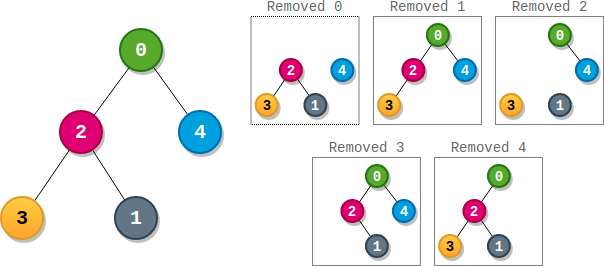
输入:parents = [-1,2,0,2,0]
输出:3
解释:
- 节点 0 的分数为:3 * 1 = 3
- 节点 1 的分数为:4 = 4
- 节点 2 的分数为:1 * 1 * 2 = 2
- 节点 3 的分数为:4 = 4
- 节点 4 的分数为:4 = 4
最高得分为 4 ,有三个节点得分为 4 (分别是节点 1,3 和 4 )。
示例 2:
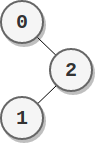
输入:parents = [-1,2,0]
输出:2
解释:
- 节点 0 的分数为:2 = 2
- 节点 1 的分数为:2 = 2
- 节点 2 的分数为:1 * 1 = 1
最高分数为 2 ,有两个节点分数为 2 (分别为节点 0 和 1 )。
提示:
n == parents.length2 <= n <= 105parents[0] == -1- 对于
i != 0,有0 <= parents[i] <= n - 1 parents表示一棵二叉树。
解题思路
方法一:DFS
我们先根据给定的父节点数组 parents 构建图 ,其中 表示节点 的所有子节点。定义变量 表示最高得分的节点数目,变量 表示最高得分。
然后,我们设计一个函数 ,它的作用是计算节点 的分数,并返回以节点 为根的子树的节点数目。
函数 的计算过程如下:
我们首先初始化变量 ,表示以节点 为根的子树的节点数目;变量 ,表示以节点 初始分数。
接下来,我们遍历节点 的所有子节点 ,如果 不是节点 的父节点 ,那么我们递归调用 ,并将返回值累乘到 中,同时将返回值累加到 中。
遍历完子节点后,如果 ,那么我们将 累乘到 中。
然后,我们判断 是否小于 ,如果小于,那么我们将 更新为 ,并将 更新为 ;如果等于,那么我们将 更新为 。
最后,我们返回 。
最终,我们调用 ,并返回 。
时间复杂度 ,空间复杂度 。其中 是节点数目。
class Solution:
    def countHighestScoreNodes(self, parents: List[int]) -> int:
        def dfs(i: int, fa: int):
            cnt = score = 1
            for j in g[i]:
                if j != fa:
                    t = dfs(j, i)
                    score *= t
                    cnt += t
            if n - cnt:
                score *= n - cnt
            nonlocal ans, mx
            if mx < score:
                mx = score
                ans = 1
            elif mx == score:
                ans += 1
            return cnt

        n = len(parents)
        g = [[] for _ in range(n)]
        for i in range(1, n):
            g[parents[i]].append(i)
        ans = mx = 0
        dfs(0, -1)
        return ans
复杂度分析
| 指标 | 值 |
|---|---|
| 时间 | Depends on the final approach |
| 空间 | Depends on the final approach |
面试官常问的追问
外企场景- question_mark
A candidate who correctly identifies the need for DFS traversal and state tracking will perform well.
- question_mark
Candidates should be comfortable with tree traversal and recognizing the implications of removing nodes in terms of subtree sizes.
- question_mark
Look for clarity in how candidates compute the scores and handle edge cases, particularly the root node.
常见陷阱
外企场景- error
Failing to correctly compute the subtree sizes, especially for the root node or leaf nodes.
- error
Not handling cases where the node has no children or only one child correctly, leading to inaccurate score calculations.
- error
Overcomplicating the solution or missing the need for DFS traversal to efficiently calculate subtree sizes.
进阶变体
外企场景- arrow_right_alt
Change the tree structure to allow more than two children per node, which will require adjusting the approach for calculating subtree sizes.
- arrow_right_alt
Introduce constraints where some nodes can be removed but not others, changing the calculation of scores based on node removal eligibility.
- arrow_right_alt
Modify the problem to consider multiple trees (forest) and determine the highest score across all trees combined.