

LeetCode 题解工作台
删除系统中的重复文件夹
由于一个漏洞,文件系统中存在许多重复文件夹。给你一个二维数组 paths ,其中 paths[i] 是一个表示文件系统中第 i 个文件夹的绝对路径的数组。 例如, ["one", "two", "three"] 表示路径 "/one/two/three" 。 如果两个文件夹(不需要在同一层级)包含 …
5
题型
5
代码语言
3
相关题
当前训练重点
困难 · 数组·哈希·扫描
答案摘要
我们可以使用字典树来存储文件夹的结构,字典树的每个节点数据如下: - `children`:一个字典,键为子文件夹的名称,值为对应的子节点。


Interview AiBoxInterview AiBox 实时 AI 助手,陪你讲清 数组·哈希·扫描 题型思路
题目描述
由于一个漏洞,文件系统中存在许多重复文件夹。给你一个二维数组 paths,其中 paths[i] 是一个表示文件系统中第 i 个文件夹的绝对路径的数组。
- 例如,
["one", "two", "three"]表示路径"/one/two/three"。
如果两个文件夹(不需要在同一层级)包含 非空且相同的 子文件夹 集合 并具有相同的子文件夹结构,则认为这两个文件夹是相同文件夹。相同文件夹的根层级 不 需要相同。如果存在两个(或两个以上)相同 文件夹,则需要将这些文件夹和所有它们的子文件夹 标记 为待删除。
- 例如,下面文件结构中的文件夹
"/a"和"/b"相同。它们(以及它们的子文件夹)应该被 全部 标记为待删除:/a/a/x/a/x/y/a/z/b/b/x/b/x/y/b/z
- 然而,如果文件结构中还包含路径
"/b/w",那么文件夹"/a"和"/b"就不相同。注意,即便添加了新的文件夹"/b/w",仍然认为"/a/x"和"/b/x"相同。
一旦所有的相同文件夹和它们的子文件夹都被标记为待删除,文件系统将会 删除 所有上述文件夹。文件系统只会执行一次删除操作。执行完这一次删除操作后,不会删除新出现的相同文件夹。
返回二维数组 ans ,该数组包含删除所有标记文件夹之后剩余文件夹的路径。路径可以按 任意顺序 返回。
示例 1:
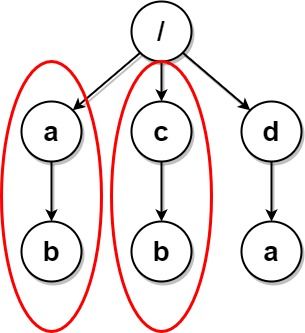
输入:paths = [["a"],["c"],["d"],["a","b"],["c","b"],["d","a"]]
输出:[["d"],["d","a"]]
解释:文件结构如上所示。
文件夹 "/a" 和 "/c"(以及它们的子文件夹)都会被标记为待删除,因为它们都包含名为 "b" 的空文件夹。
示例 2:
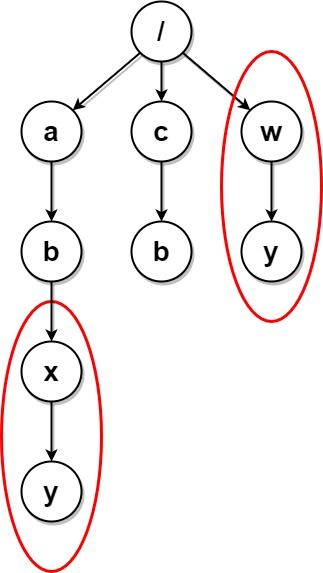
输入:paths = [["a"],["c"],["a","b"],["c","b"],["a","b","x"],["a","b","x","y"],["w"],["w","y"]]
输出:[["c"],["c","b"],["a"],["a","b"]]
解释:文件结构如上所示。
文件夹 "/a/b/x" 和 "/w"(以及它们的子文件夹)都会被标记为待删除,因为它们都包含名为 "y" 的空文件夹。
注意,文件夹 "/a" 和 "/c" 在删除后变为相同文件夹,但这两个文件夹不会被删除,因为删除只会进行一次,且它们没有在删除前被标记。
示例 3:
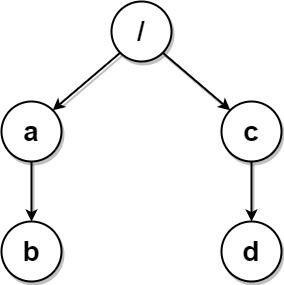
输入:paths = [["a","b"],["c","d"],["c"],["a"]]
输出:[["c"],["c","d"],["a"],["a","b"]]
解释:文件系统中所有文件夹互不相同。
注意,返回的数组可以按不同顺序返回文件夹路径,因为题目对顺序没有要求。
示例 4:
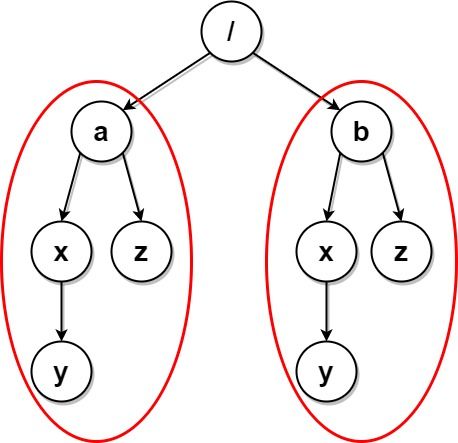
输入:paths = [["a"],["a","x"],["a","x","y"],["a","z"],["b"],["b","x"],["b","x","y"],["b","z"]]
输出:[]
解释:文件结构如上所示。
文件夹 "/a/x" 和 "/b/x"(以及它们的子文件夹)都会被标记为待删除,因为它们都包含名为 "y" 的空文件夹。
文件夹 "/a" 和 "/b"(以及它们的子文件夹)都会被标记为待删除,因为它们都包含一个名为 "z" 的空文件夹以及上面提到的文件夹 "x" 。
示例 5:
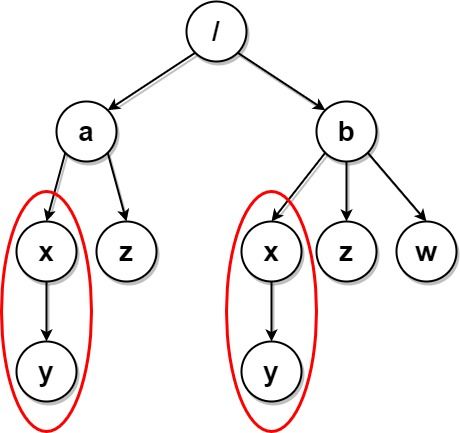
输入:paths = [["a"],["a","x"],["a","x","y"],["a","z"],["b"],["b","x"],["b","x","y"],["b","z"],["b","w"]]
输出:[["b"],["b","w"],["b","z"],["a"],["a","z"]]
解释:本例与上例的结构基本相同,除了新增 "/b/w" 文件夹。
文件夹 "/a/x" 和 "/b/x" 仍然会被标记,但 "/a" 和 "/b" 不再被标记,因为 "/b" 中有名为 "w" 的空文件夹而 "/a" 没有。
注意,"/a/z" 和 "/b/z" 不会被标记,因为相同子文件夹的集合必须是非空集合,但这两个文件夹都是空的。
提示:
1 <= paths.length <= 2 * 1041 <= paths[i].length <= 5001 <= paths[i][j].length <= 101 <= sum(paths[i][j].length) <= 2 * 105path[i][j]由小写英文字母组成- 不会存在两个路径都指向同一个文件夹的情况
- 对于不在根层级的任意文件夹,其父文件夹也会包含在输入中
解题思路
方法一:字典树 + DFS
我们可以使用字典树来存储文件夹的结构,字典树的每个节点数据如下:
children:一个字典,键为子文件夹的名称,值为对应的子节点。deleted:一个布尔值,表示该节点是否被标记为待删除。
我们将所有路径插入到字典树中,然后使用 DFS 遍历字典树,构建每个子树的字符串表示。对于每个子树,如果它的字符串表示已经存在于一个全局字典中,则将该节点和全局字典中的对应节点都标记为待删除。最后,再次使用 DFS 遍历字典树,将未被标记的节点的路径添加到结果列表中。
class Trie:
    def __init__(self):
        self.children: Dict[str, "Trie"] = defaultdict(Trie)
        self.deleted: bool = False


class Solution:
    def deleteDuplicateFolder(self, paths: List[List[str]]) -> List[List[str]]:
        root = Trie()
        for path in paths:
            cur = root
            for name in path:
                if cur.children[name] is None:
                    cur.children[name] = Trie()
                cur = cur.children[name]

        g: Dict[str, Trie] = {}

        def dfs(node: Trie) -> str:
            if not node.children:
                return ""
            subs: List[str] = []
            for name, child in node.children.items():
                subs.append(f"{name}({dfs(child)})")
            s = "".join(sorted(subs))
            if s in g:
                node.deleted = g[s].deleted = True
            else:
                g[s] = node
            return s

        def dfs2(node: Trie) -> None:
            if node.deleted:
                return
            if path:
                ans.append(path[:])
            for name, child in node.children.items():
                path.append(name)
                dfs2(child)
                path.pop()

        dfs(root)
        ans: List[List[str]] = []
        path: List[str] = []
        dfs2(root)
        return ans
复杂度分析
| 指标 | 值 |
|---|---|
| 时间 | Depends on the final approach |
| 空间 | Depends on the final approach |
面试官常问的追问
外企场景- question_mark
They want you to notice that duplicate detection is based on subtree structure, so rebuilding the hierarchy is more important than sorting raw paths.
- question_mark
If they ask about a trie, they are steering you away from pairwise folder comparison, which is too slow and misses recursive structure.
- question_mark
If they stress that deletion runs once, they are testing whether you separate detection from removal instead of deleting during the first DFS.
常见陷阱
外企场景- error
Treating empty folders as duplicate signatures to delete automatically. In this problem, duplicate folders must have a non-empty set of subfolders.
- error
Serializing children without a stable canonical order, which can make identical subtrees produce different signatures depending on insertion order.
- error
Deleting folders as soon as a duplicate is found, which incorrectly removes folders that only become identical after the initial deletion pass.
进阶变体
外企场景- arrow_right_alt
Return the number of deleted folders instead of the remaining paths, which still uses the same trie plus subtree signature pass.
- arrow_right_alt
Treat files as labeled leaves in addition to folders, so the serialization must include both file names and child folder signatures.
- arrow_right_alt
Support repeated cleanup rounds until no duplicates remain, which changes the one-pass rule and requires iterative rebuild or repeated marking.