

LeetCode 题解工作台
将有序数组转换为二叉搜索树
给你一个整数数组 nums ,其中元素已经按 升序 排列,请你将其转换为一棵 平衡 二叉搜索树。 示例 1: 输入: nums = [-10,-3,0,5,9] 输出: [0,-3,9,-10,null,5] 解释: [0,-10,5,null,-3,null,9] 也将被视为正确答案: 示例 2:…
5
题型
8
代码语言
3
相关题
当前训练重点
简单 · 二分·树·traversal
答案摘要
我们设计一个递归函数 $\textit{dfs}(l, r)$,表示当前待构造的二叉搜索树的节点值都在数组 的下标范围 $[l, r]$ 内。该函数返回构造出的二叉搜索树的根节点。 函数 $\textit{dfs}(l, r)$ 的执行流程如下:


Interview AiBoxInterview AiBox 实时 AI 助手,陪你讲清 二分·树·traversal 题型思路
题目描述
给你一个整数数组 nums ,其中元素已经按 升序 排列,请你将其转换为一棵 平衡 二叉搜索树。
示例 1:
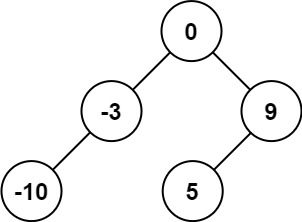
输入:nums = [-10,-3,0,5,9]
输出:[0,-3,9,-10,null,5]
解释:[0,-10,5,null,-3,null,9] 也将被视为正确答案: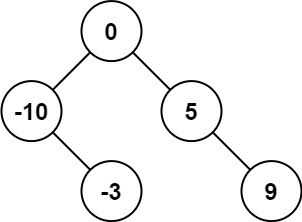
示例 2:
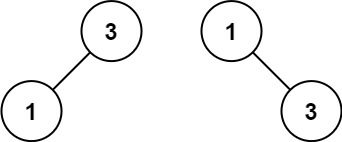
输入:nums = [1,3]
输出:[3,1]
解释:[1,null,3] 和 [3,1] 都是高度平衡二叉搜索树。
提示:
1 <= nums.length <= 104-104 <= nums[i] <= 104nums按 严格递增 顺序排列
解题思路
方法一:二分 + 递归
我们设计一个递归函数 ,表示当前待构造的二叉搜索树的节点值都在数组 的下标范围 内。该函数返回构造出的二叉搜索树的根节点。
函数 的执行流程如下:
- 如果 ,说明当前数组为空,返回
null。 - 如果 ,取数组中下标为 的元素作为当前二叉搜索树的根节点,其中 表示对 向下取整。
- 递归地构造当前二叉搜索树的左子树,其根节点的值为数组中下标为 的元素,左子树的节点值都在数组的下标范围 内。
- 递归地构造当前二叉搜索树的右子树,其根节点的值为数组中下标为 的元素,右子树的节点值都在数组的下标范围 内。
- 返回当前二叉搜索树的根节点。
答案即为函数 的返回值。
时间复杂度 ,空间复杂度 。其中 为数组 的长度。
# Definition for a binary tree node.
# class TreeNode:
#     def __init__(self, val=0, left=None, right=None):
#         self.val = val
#         self.left = left
#         self.right = right
class Solution:
    def sortedArrayToBST(self, nums: List[int]) -> Optional[TreeNode]:
        def dfs(l: int, r: int) -> Optional[TreeNode]:
            if l > r:
                return None
            mid = (l + r) >> 1
            return TreeNode(nums[mid], dfs(l, mid - 1), dfs(mid + 1, r))

        return dfs(0, len(nums) - 1)
复杂度分析
| 指标 | 值 |
|---|---|
| 时间 | Depends on the final approach |
| 空间 | Depends on the final approach |
面试官常问的追问
外企场景- question_mark
Do you see that choosing the middle element is what satisfies both BST ordering and height balance at the same time?
- question_mark
Can you explain why using left and right indices is safer here than repeatedly slicing the array into subarrays?
- question_mark
Will you handle even-length ranges consistently and show that either middle choice still produces a valid height-balanced BST?
常见陷阱
外企场景- error
Using the first or last element as each root, which preserves BST order but creates a skewed tree instead of a height-balanced one.
- error
Recursing on the wrong ranges, such as including mid in a child call again, which causes infinite recursion or duplicate nodes.
- error
Building with array slices everywhere, which still works logically but quietly increases memory use and can hurt performance on large inputs.
进阶变体
外企场景- arrow_right_alt
Convert a sorted singly linked list to a height-balanced BST, where random access is gone and midpoint handling changes.
- arrow_right_alt
Build the BST iteratively from a sorted array using an explicit queue or stack of index ranges instead of recursion.
- arrow_right_alt
Given a sorted array, return any height-balanced BST but prefer the left middle or right middle consistently for even-length segments.