

LeetCode 题解工作台
从二叉树一个节点到另一个节点每一步的方向
给你一棵 二叉树 的根节点 root ,这棵二叉树总共有 n 个节点。每个节点的值为 1 到 n 中的一个整数,且互不相同。给你一个整数 startValue ,表示起点节点 s 的值,和另一个不同的整数 destValue ,表示终点节点 t 的值。 请找到从节点 s 到节点 t 的 最短路径 ,…
4
题型
6
代码语言
3
相关题
当前训练重点
中等 · 二分·树·traversal
答案摘要
我们可以先找到节点 和 的最近公共祖先,记为 ,然后分别从 出发,找到 和 的路径。那么从 到 的路径就是 的个数,从 到 的路径就是 的路径,最后将这两个路径拼接起来即可。 时间复杂度 ,空间复杂度 。其中 为二叉树的节点数。


Interview AiBoxInterview AiBox 实时 AI 助手,陪你讲清 二分·树·traversal 题型思路
题目描述
给你一棵 二叉树 的根节点 root ,这棵二叉树总共有 n 个节点。每个节点的值为 1 到 n 中的一个整数,且互不相同。给你一个整数 startValue ,表示起点节点 s 的值,和另一个不同的整数 destValue ,表示终点节点 t 的值。
请找到从节点 s 到节点 t 的 最短路径 ,并以字符串的形式返回每一步的方向。每一步用 大写 字母 'L' ,'R' 和 'U' 分别表示一种方向:
'L'表示从一个节点前往它的 左孩子 节点。'R'表示从一个节点前往它的 右孩子 节点。'U'表示从一个节点前往它的 父 节点。
请你返回从 s 到 t 最短路径 每一步的方向。
示例 1:
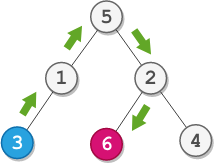
输入:root = [5,1,2,3,null,6,4], startValue = 3, destValue = 6
输出:"UURL"
解释:最短路径为:3 → 1 → 5 → 2 → 6 。
示例 2:

输入:root = [2,1], startValue = 2, destValue = 1
输出:"L"
解释:最短路径为:2 → 1 。
提示:
- 树中节点数目为
n。 2 <= n <= 1051 <= Node.val <= n- 树中所有节点的值 互不相同 。
1 <= startValue, destValue <= nstartValue != destValue
解题思路
方法一:最近公共祖先 + DFS
我们可以先找到节点 和 的最近公共祖先,记为 ,然后分别从 出发,找到 和 的路径。那么从 到 的路径就是 的个数,从 到 的路径就是 的路径,最后将这两个路径拼接起来即可。
时间复杂度 ,空间复杂度 。其中 为二叉树的节点数。
# Definition for a binary tree node.
# class TreeNode:
#     def __init__(self, val=0, left=None, right=None):
#         self.val = val
#         self.left = left
#         self.right = right


class Solution:
    def getDirections(
        self, root: Optional[TreeNode], startValue: int, destValue: int
    ) -> str:
        def lca(node: Optional[TreeNode], p: int, q: int):
            if node is None or node.val in (p, q):
                return node
            left = lca(node.left, p, q)
            right = lca(node.right, p, q)
            if left and right:
                return node
            return left or right

        def dfs(node: Optional[TreeNode], x: int, path: List[str]):
            if node is None:
                return False
            if node.val == x:
                return True
            path.append("L")
            if dfs(node.left, x, path):
                return True
            path[-1] = "R"
            if dfs(node.right, x, path):
                return True
            path.pop()
            return False

        node = lca(root, startValue, destValue)

        path_to_start = []
        path_to_dest = []

        dfs(node, startValue, path_to_start)
        dfs(node, destValue, path_to_dest)

        return "U" * len(path_to_start) + "".join(path_to_dest)
复杂度分析
| 指标 | 值 |
|---|---|
| 时间 | O(n) |
| 空间 | O(n) |
面试官常问的追问
外企场景- question_mark
Look for an understanding of tree traversal techniques, especially in the context of Lowest Common Ancestor (LCA).
- question_mark
Check for an efficient approach, where the traversal doesn't revisit nodes unnecessarily.
- question_mark
Expect clarity in constructing the path with the correct sequence of 'L', 'R', and 'U' directions.
常见陷阱
外企场景- error
Confusing the order of traversal—ensure the solution moves up first and then down to the destination node.
- error
Overcomplicating the LCA search—opt for a simple recursive or iterative approach.
- error
Failing to handle edge cases, such as when the start node is the parent of the destination node.
进阶变体
外企场景- arrow_right_alt
The problem can be varied by providing additional constraints, such as limiting the tree to binary search trees (BST).
- arrow_right_alt
Another variant might require returning the path as an array of node values instead of directions.
- arrow_right_alt
For larger trees, the pathfinding method could be tested with variations in node depth or balance.