

LeetCode 题解工作台
第 K 条最小指令
Bob 站在单元格 (0, 0) ,想要前往目的地 destination : (row, column) 。他只能向 右 或向 下 走。你可以为 Bob 提供导航 指令 来帮助他到达目的地 destination 。 指令 用字符串表示,其中每个字符: 'H' ,意味着水平向右移动 'V' ,意味…
4
题型
4
代码语言
3
相关题
当前训练重点
困难 · 状态·转移·动态规划
答案摘要
根据题目描述我们可以知道,最终的路径是由 个 `'V'` 和 个 `'H'` 组成的,且按字典序排列后的第 条最小指令。 我们首先考虑字典序的最高位,即最左边的字符。如果高位字符是 `'V'`,那么所有以 `'H'` 开头的路径的字典序都比它小,而以 `'H'` 开头的路径总数为 $x = C_{v+h-1}^{h-1}$。


Interview AiBoxInterview AiBox 实时 AI 助手,陪你讲清 状态·转移·动态规划 题型思路
题目描述
Bob 站在单元格 (0, 0) ,想要前往目的地 destination :(row, column) 。他只能向 右 或向 下 走。你可以为 Bob 提供导航 指令 来帮助他到达目的地 destination 。
指令 用字符串表示,其中每个字符:
'H',意味着水平向右移动'V',意味着竖直向下移动
能够为 Bob 导航到目的地 destination 的指令可以有多种,例如,如果目的地 destination 是 (2, 3),"HHHVV" 和 "HVHVH" 都是有效 指令 。
然而,Bob 很挑剔。因为他的幸运数字是 k,他想要遵循 按字典序排列后的第 k 条最小指令 的导航前往目的地 destination 。k 的编号 从 1 开始 。
给你一个整数数组 destination 和一个整数 k ,请你返回可以为 Bob 提供前往目的地 destination 导航的 按字典序排列后的第 k 条最小指令 。
示例 1:
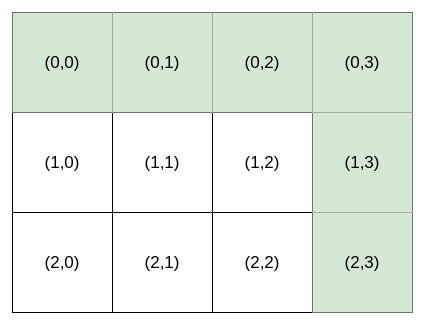
输入:destination = [2,3], k = 1
输出:"HHHVV"
解释:能前往 (2, 3) 的所有导航指令 按字典序排列后 如下所示:
["HHHVV", "HHVHV", "HHVVH", "HVHHV", "HVHVH", "HVVHH", "VHHHV", "VHHVH", "VHVHH", "VVHHH"].
示例 2:
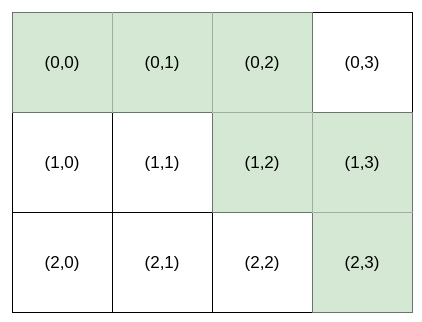
输入:destination = [2,3], k = 2
输出:"HHVHV"
示例 3:
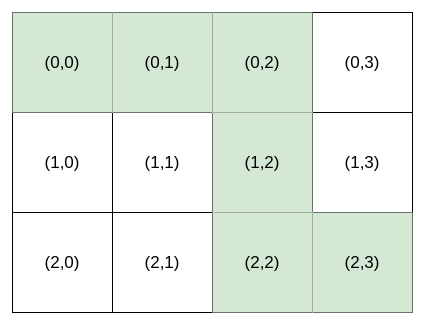
输入:destination = [2,3], k = 3
输出:"HHVVH"
提示:
destination.length == 21 <= row, column <= 151 <= k <= nCr(row + column, row),其中nCr(a, b)表示组合数,即从a个物品中选b个物品的不同方案数。
解题思路
方法一:组合计数
根据题目描述我们可以知道,最终的路径是由 个 'V' 和 个 'H' 组成的,且按字典序排列后的第 条最小指令。
我们首先考虑字典序的最高位,即最左边的字符。如果高位字符是 'V',那么所有以 'H' 开头的路径的字典序都比它小,而以 'H' 开头的路径总数为 。
如果 ,那么高位字符一定是 'V',我们将 减去 ,并将 减 ,然后继续考虑下一位字符;否则,高位字符一定是 'H',我们将 减 ,然后继续考虑下一位字符。
注意,如果 ,那么高位字符一定是 'V',因为剩下的字符都是 'V'。
问题可以转换为求解 ,我们可以通过公式 递推求解。
时间复杂度 ,空间复杂度 。其中 和 分别为 和 。
class Solution:
    def kthSmallestPath(self, destination: List[int], k: int) -> str:
        v, h = destination
        ans = []
        for _ in range(h + v):
            if h == 0:
                ans.append("V")
            else:
                x = comb(h + v - 1, h - 1)
                if k > x:
                    ans.append("V")
                    v -= 1
                    k -= x
                else:
                    ans.append("H")
                    h -= 1
        return "".join(ans)
复杂度分析
| 指标 | 值 |
|---|---|
| 时间 | Depends on the final approach |
| 空间 | Depends on the final approach |
面试官常问的追问
外企场景- question_mark
The candidate demonstrates understanding of dynamic programming and combinatorics.
- question_mark
The candidate efficiently applies binomial coefficients to reduce the problem complexity.
- question_mark
The candidate navigates the state transition approach to solve the problem without brute-forcing all paths.
常见陷阱
外企场景- error
Forgetting to consider the lexicographical order of instructions, leading to incorrect kth sequences.
- error
Miscomputing the binomial coefficients, resulting in an inefficient or incorrect path count.
- error
Not using dynamic programming to optimize the calculation of intermediate results, leading to unnecessary recomputation.
进阶变体
外企场景- arrow_right_alt
Given a different destination (row, column), how would the approach change?
- arrow_right_alt
How would you modify the approach for finding the largest lexicographical instruction sequence?
- arrow_right_alt
What happens if there are constraints on the number of right or down moves allowed?