

LeetCode 题解工作台
相交链表
给你两个单链表的头节点 headA 和 headB ,请你找出并返回两个单链表相交的起始节点。如果两个链表不存在相交节点,返回 null 。 图示两个链表在节点 c1 开始相交 : 题目数据 保证 整个链式结构中不存在环。 注意 ,函数返回结果后,链表必须 保持其原始结构 。 自定义评测: 评测系统…
3
题型
7
代码语言
3
相关题
当前训练重点
简单 · 链表指针操作
答案摘要
我们使用两个指针 , 分别指向两个链表 , 。 同时遍历链表,当 到达链表 的末尾时,重新定位到链表 的头节点;当 到达链表 的末尾时,重新定位到链表 的头节点。


Interview AiBoxInterview AiBox 实时 AI 助手,陪你讲清 链表指针操作 题型思路
题目描述
给你两个单链表的头节点 headA 和 headB ,请你找出并返回两个单链表相交的起始节点。如果两个链表不存在相交节点,返回 null 。
图示两个链表在节点 c1 开始相交:
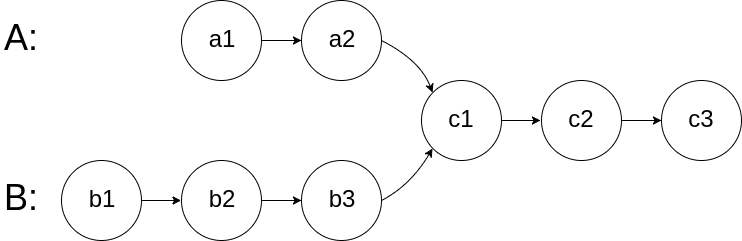
题目数据 保证 整个链式结构中不存在环。
注意,函数返回结果后,链表必须 保持其原始结构 。
自定义评测:
评测系统 的输入如下(你设计的程序 不适用 此输入):
intersectVal- 相交的起始节点的值。如果不存在相交节点,这一值为0listA- 第一个链表listB- 第二个链表skipA- 在listA中(从头节点开始)跳到交叉节点的节点数skipB- 在listB中(从头节点开始)跳到交叉节点的节点数
评测系统将根据这些输入创建链式数据结构,并将两个头节点 headA 和 headB 传递给你的程序。如果程序能够正确返回相交节点,那么你的解决方案将被 视作正确答案 。
示例 1:
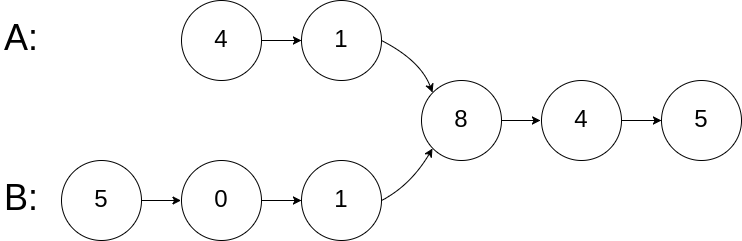
输入:intersectVal = 8, listA = [4,1,8,4,5], listB = [5,6,1,8,4,5], skipA = 2, skipB = 3
输出:Intersected at '8'
解释:相交节点的值为 8 (注意,如果两个链表相交则不能为 0)。
从各自的表头开始算起,链表 A 为 [4,1,8,4,5],链表 B 为 [5,6,1,8,4,5]。
在 A 中,相交节点前有 2 个节点;在 B 中,相交节点前有 3 个节点。
— 请注意相交节点的值不为 1,因为在链表 A 和链表 B 之中值为 1 的节点 (A 中第二个节点和 B 中第三个节点) 是不同的节点。换句话说,它们在内存中指向两个不同的位置,而链表 A 和链表 B 中值为 8 的节点 (A 中第三个节点,B 中第四个节点) 在内存中指向相同的位置。
示例 2:
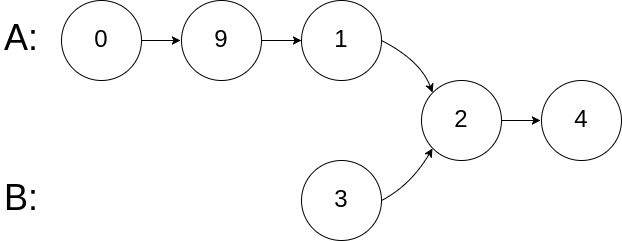
输入:intersectVal = 2, listA = [1,9,1,2,4], listB = [3,2,4], skipA = 3, skipB = 1
输出:Intersected at '2'
解释:相交节点的值为 2 (注意,如果两个链表相交则不能为 0)。
从各自的表头开始算起,链表 A 为 [1,9,1,2,4],链表 B 为 [3,2,4]。
在 A 中,相交节点前有 3 个节点;在 B 中,相交节点前有 1 个节点。
示例 3:
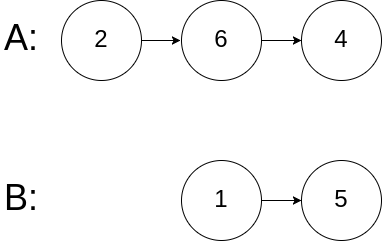
输入:intersectVal = 0, listA = [2,6,4], listB = [1,5], skipA = 3, skipB = 2
输出:No intersection
解释:从各自的表头开始算起,链表 A 为 [2,6,4],链表 B 为 [1,5]。
由于这两个链表不相交,所以 intersectVal 必须为 0,而 skipA 和 skipB 可以是任意值。
这两个链表不相交,因此返回 null 。
提示:
listA中节点数目为mlistB中节点数目为n1 <= m, n <= 3 * 1041 <= Node.val <= 1050 <= skipA <= m0 <= skipB <= n- 如果
listA和listB没有交点,intersectVal为0 - 如果
listA和listB有交点,intersectVal == listA[skipA] == listB[skipB]
进阶:你能否设计一个时间复杂度 O(m + n) 、仅用 O(1) 内存的解决方案?
解题思路
方法一:双指针
我们使用两个指针 , 分别指向两个链表 , 。
同时遍历链表,当 到达链表 的末尾时,重新定位到链表 的头节点;当 到达链表 的末尾时,重新定位到链表 的头节点。
若两指针相遇,所指向的结点就是第一个公共节点。若没相遇,说明两链表无公共节点,此时两个指针都指向 null,返回其中一个即可。
时间复杂度 ,其中 和 分别是链表 和 的长度。空间复杂度 。
# Definition for singly-linked list.
# class ListNode:
#     def __init__(self, x):
#         self.val = x
#         self.next = None


class Solution:
    def getIntersectionNode(self, headA: ListNode, headB: ListNode) -> ListNode:
        a, b = headA, headB
        while a != b:
            a = a.next if a else headB
            b = b.next if b else headA
        return a
复杂度分析
| 指标 | 值 |
|---|---|
| 时间 | Depends on the final approach |
| 空间 | Depends on the final approach |
面试官常问的追问
外企场景- question_mark
Look for a solution using pointer manipulation and minimal space.
- question_mark
Evaluate if the candidate can optimize the solution for both time and space complexity.
- question_mark
Check whether the candidate can explain the trade-offs between using hash tables and the two-pointer technique.
常见陷阱
外企场景- error
Confusing value equality with reference equality: Make sure to check if the nodes are identical in memory, not just equal in value.
- error
Failure to handle cases with no intersection correctly: The code should return null when no intersection is found.
- error
Incorrect space complexity considerations when using Hash Tables: Candidates might underestimate memory usage when opting for hash tables.
进阶变体
外企场景- arrow_right_alt
What if the two linked lists have a large number of nodes? Consider optimizing the solution further.
- arrow_right_alt
How would you handle the case where one list is much longer than the other? The two-pointer method accounts for this.
- arrow_right_alt
Can the problem be solved with just a single traversal? It depends on the method used—hash tables or two pointers.