

LeetCode 题解工作台
T 秒后青蛙的位置
给你一棵由 n 个顶点组成的无向树,顶点编号从 1 到 n 。青蛙从 顶点 1 开始起跳。规则如下: 在一秒内,青蛙从它所在的当前顶点跳到另一个 未访问 过的顶点(如果它们直接相连)。 青蛙无法跳回已经访问过的顶点。 如果青蛙可以跳到多个不同顶点,那么它跳到其中任意一个顶点上的机率都相同。 如果青蛙…
4
题型
6
代码语言
3
相关题
当前训练重点
困难 · 图·DFS·traversal
答案摘要
我们先根据题目给出的无向树的边,建立一个邻接表 ,其中 表示顶点 的所有相邻顶点。 然后,我们定义以下数据结构:


Interview AiBoxInterview AiBox 实时 AI 助手,陪你讲清 图·DFS·traversal 题型思路
题目描述
给你一棵由 n 个顶点组成的无向树,顶点编号从 1 到 n。青蛙从 顶点 1 开始起跳。规则如下:
- 在一秒内,青蛙从它所在的当前顶点跳到另一个 未访问 过的顶点(如果它们直接相连)。
- 青蛙无法跳回已经访问过的顶点。
- 如果青蛙可以跳到多个不同顶点,那么它跳到其中任意一个顶点上的机率都相同。
- 如果青蛙不能跳到任何未访问过的顶点上,那么它每次跳跃都会停留在原地。
无向树的边用数组 edges 描述,其中 edges[i] = [ai, bi] 意味着存在一条直接连通 ai 和 bi 两个顶点的边。
返回青蛙在 t 秒后位于目标顶点 target 上的概率。与实际答案相差不超过 10-5 的结果将被视为正确答案。
示例 1:
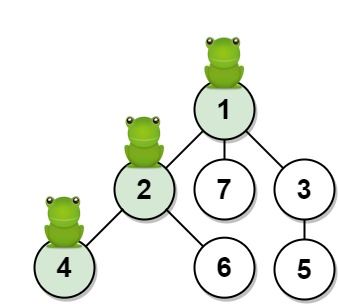
输入:n = 7, edges = [[1,2],[1,3],[1,7],[2,4],[2,6],[3,5]], t = 2, target = 4
输出:0.16666666666666666
解释:上图显示了青蛙的跳跃路径。青蛙从顶点 1 起跳,第 1 秒 有 1/3 的概率跳到顶点 2 ,然后第 2 秒 有 1/2 的概率跳到顶点 4,因此青蛙在 2 秒后位于顶点 4 的概率是 1/3 * 1/2 = 1/6 = 0.16666666666666666 。
示例 2:
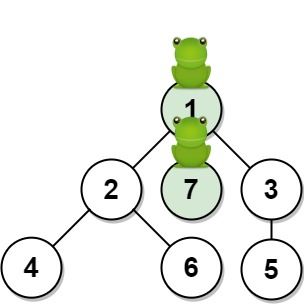
输入:n = 7, edges = [[1,2],[1,3],[1,7],[2,4],[2,6],[3,5]], t = 1, target = 7
输出:0.3333333333333333
解释:上图显示了青蛙的跳跃路径。青蛙从顶点 1 起跳,有 1/3 = 0.3333333333333333 的概率能够 1 秒 后跳到顶点 7 。
提示:
1 <= n <= 100edges.length == n - 1edges[i].length == 21 <= ai, bi <= n1 <= t <= 501 <= target <= n
解题思路
方法一:BFS
我们先根据题目给出的无向树的边,建立一个邻接表 ,其中 表示顶点 的所有相邻顶点。
然后,我们定义以下数据结构:
- 队列 ,用于存储每一轮搜索的顶点及其概率,初始时 ,表示青蛙在顶点 的概率为 ;
- 数组 ,用于记录每个顶点是否被访问过,初始时 ,其余元素均为 。
接下来,我们开始进行广度优先搜索。
在每一轮搜索中,我们每次取出队首元素 ,其中 和 分别表示当前顶点及其概率。当前顶点 的相邻顶点中未被访问过的顶点的个数记为 。
- 如果 ,说明青蛙已经到达目标顶点,此时我们判断青蛙是否在 秒到达目标顶点,或者不到 秒到达目标顶点但是无法再跳跃到其它顶点(即 或者 )。如果是,则返回 ,否则返回 。
- 如果 ,那么我们将概率 均分给 的所有未被访问过的相邻顶点,然后将这些顶点加入队列 中,并且将这些顶点标记为已访问。
在一轮搜索结束后,我们将 减少 ,然后继续进行下一轮搜索,直到队列为空或者 。
最后,若青蛙仍然没有到达目标顶点,那么我们返回 。
时间复杂度 ,空间复杂度 。其中 是无向树的顶点数。
class Solution:
    def frogPosition(
        self, n: int, edges: List[List[int]], t: int, target: int
    ) -> float:
        g = defaultdict(list)
        for u, v in edges:
            g[u].append(v)
            g[v].append(u)
        q = deque([(1, 1.0)])
        vis = [False] * (n + 1)
        vis[1] = True
        while q and t >= 0:
            for _ in range(len(q)):
                u, p = q.popleft()
                cnt = len(g[u]) - int(u != 1)
                if u == target:
                    return p if cnt * t == 0 else 0
                for v in g[u]:
                    if not vis[v]:
                        vis[v] = True
                        q.append((v, p / cnt))
            t -= 1
        return 0
复杂度分析
| 指标 | 值 |
|---|---|
| 时间 | Depends on the final approach |
| 空间 | Depends on the final approach |
面试官常问的追问
外企场景- question_mark
The candidate can efficiently solve the problem using DFS with memoization.
- question_mark
The candidate can explain how to handle the random jumps in the tree graph.
- question_mark
The candidate can discuss edge cases, such as when the frog cannot move or stays on a vertex.
常见陷阱
外企场景- error
Forgetting to account for the case where the frog stays on the same vertex after all possible moves are visited.
- error
Not properly dividing the probability when multiple vertices are available for the frog to jump to.
- error
Failing to optimize the DFS approach with memoization, leading to excessive recomputation.
进阶变体
外企场景- arrow_right_alt
The frog jumps with a probability to any of the connected vertices, including cases where some vertices are visited earlier.
- arrow_right_alt
The tree can be directed, where the frog can only jump in one direction based on the tree structure.
- arrow_right_alt
Change the problem to ask for the probability of being on a vertex after a specific number of jumps, not time.