

LeetCode 题解工作台
检测正方形
给你一个在 X-Y 平面上的点构成的数据流。设计一个满足下述要求的算法: 添加 一个在数据流中的新点到某个数据结构中 。 可以添加 重复 的点,并会视作不同的点进行处理。 给你一个查询点,请你从数据结构中选出三个点,使这三个点和查询点一同构成一个 面积为正 的 轴对齐正方形 , 统计 满足该要求的方…
4
题型
4
代码语言
3
相关题
当前训练重点
中等 · 数组·哈希·扫描
答案摘要
我们可以用一个哈希表 维护所有点的信息,其中 表示点 $(x, y)$ 的个数。 当调用 $add(x, y)$ 方法时,我们将 的值加 。


Interview AiBoxInterview AiBox 实时 AI 助手,陪你讲清 数组·哈希·扫描 题型思路
题目描述
给你一个在 X-Y 平面上的点构成的数据流。设计一个满足下述要求的算法:
- 添加 一个在数据流中的新点到某个数据结构中。可以添加 重复 的点,并会视作不同的点进行处理。
- 给你一个查询点,请你从数据结构中选出三个点,使这三个点和查询点一同构成一个 面积为正 的 轴对齐正方形 ,统计 满足该要求的方案数目。
轴对齐正方形 是一个正方形,除四条边长度相同外,还满足每条边都与 x-轴 或 y-轴 平行或垂直。
实现 DetectSquares 类:
DetectSquares()使用空数据结构初始化对象void add(int[] point)向数据结构添加一个新的点point = [x, y]int count(int[] point)统计按上述方式与点point = [x, y]共同构造 轴对齐正方形 的方案数。
示例:
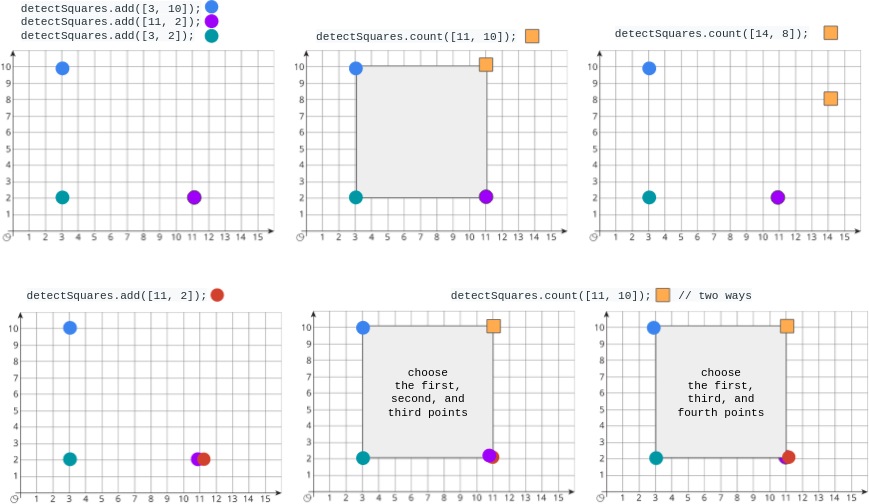
输入:
["DetectSquares", "add", "add", "add", "count", "count", "add", "count"]
[[], [[3, 10]], [[11, 2]], [[3, 2]], [[11, 10]], [[14, 8]], [[11, 2]], [[11, 10]]]
输出:
[null, null, null, null, 1, 0, null, 2]

解释:
DetectSquares detectSquares = new DetectSquares();
detectSquares.add([3, 10]);
detectSquares.add([11, 2]);
detectSquares.add([3, 2]);
detectSquares.count([11, 10]); // 返回 1 。你可以选择:
// - 第一个,第二个,和第三个点
detectSquares.count([14, 8]); // 返回 0 。查询点无法与数据结构中的这些点构成正方形。
detectSquares.add([11, 2]); // 允许添加重复的点。
detectSquares.count([11, 10]); // 返回 2 。你可以选择:
// - 第一个,第二个,和第三个点
// - 第一个,第三个,和第四个点
提示:
point.length == 20 <= x, y <= 1000- 调用
add和count的 总次数 最多为5000
解题思路
方法一:哈希表
我们可以用一个哈希表 维护所有点的信息,其中 表示点 的个数。
当调用 方法时,我们将 的值加 。
当调用 方法时,我们需要获取另外的三个点,构成一个轴对齐正方形。我们可以枚举平行于 轴且与 的距离为 的点 ,如果存在这样的点,根据这两个点,我们可以确定另外两个点为 和 ,或者 和 。我们将这两种情况的方案数累加即可。
时间复杂度方面,调用 方法的时间复杂度为 ,调用 方法的时间复杂度为 ;空间复杂度为 。其中 为数据流中的点的个数。
class DetectSquares:
    def __init__(self):
        self.cnt = defaultdict(Counter)

    def add(self, point: List[int]) -> None:
        x, y = point
        self.cnt[x][y] += 1

    def count(self, point: List[int]) -> int:
        x1, y1 = point
        if x1 not in self.cnt:
            return 0
        ans = 0
        for x2 in self.cnt.keys():
            if x2 != x1:
                d = x2 - x1
                ans += self.cnt[x2][y1] * self.cnt[x1][y1 + d] * self.cnt[x2][y1 + d]
                ans += self.cnt[x2][y1] * self.cnt[x1][y1 - d] * self.cnt[x2][y1 - d]
        return ans


# Your DetectSquares object will be instantiated and called as such:
# obj = DetectSquares()
# obj.add(point)
# param_2 = obj.count(point)
复杂度分析
| 指标 | 值 |
|---|---|
| 时间 | Depends on the final approach |
| 空间 | Depends on the final approach |
面试官常问的追问
外企场景- question_mark
Asks about handling duplicate points and counting their contribution to squares.
- question_mark
Probes understanding of hash map use for constant-time lookup in geometric problems.
- question_mark
Checks if candidate points are scanned efficiently along shared coordinates rather than all points.
常见陷阱
外企场景- error
Failing to account for duplicate points when counting squares, leading to undercounting.
- error
Iterating over all stored points instead of only those sharing x or y coordinates, causing slow queries.
- error
Incorrectly calculating positions of the other two square vertices, missing valid squares.
进阶变体
外企场景- arrow_right_alt
Count rectangles instead of squares using similar hash map frequency logic.
- arrow_right_alt
Handle dynamic deletion of points while still efficiently counting squares.
- arrow_right_alt
Extend to 3D to count axis-aligned cubes using a three-level nested hash map.