

LeetCode 题解工作台
在带权树网络中统计可连接服务器对数目
给你一棵无根带权树,树中总共有 n 个节点,分别表示 n 个服务器,服务器从 0 到 n - 1 编号。同时给你一个数组 edges ,其中 edges[i] = [a i , b i , weight i ] 表示节点 a i 和 b i 之间有一条双向边,边的权值为 weight i 。再给你一…
3
题型
5
代码语言
3
相关题
当前训练重点
中等 · 二分·树·traversal
答案摘要
我们先根据题目给定的边构建出一个邻接表 ,其中 表示节点 的所有邻居节点以及对应的边权。 然后,我们可以枚举每一个节点 作为连接的中间节点,通过深度优先搜索计算出从 的邻居节点 出发的,且到节点 的距离可以被 整除的节点数 。那么,节点 的可连接节点对数目增加了 $s \times t$,其中 表示节点 的邻居节点 出发的,且到节点 的距离不可以被 整除的累计节点数。然后…


Interview AiBoxInterview AiBox 实时 AI 助手,陪你讲清 二分·树·traversal 题型思路
题目描述
给你一棵无根带权树,树中总共有 n 个节点,分别表示 n 个服务器,服务器从 0 到 n - 1 编号。同时给你一个数组 edges ,其中 edges[i] = [ai, bi, weighti] 表示节点 ai 和 bi 之间有一条双向边,边的权值为 weighti 。再给你一个整数 signalSpeed 。
如果两台服务器 a 和 b 是通过服务器 c 可连接的,则:
a < b,a != c且b != c。- 从
c到a的距离是可以被signalSpeed整除的。 - 从
c到b的距离是可以被signalSpeed整除的。 - 从
c到b的路径与从c到a的路径没有任何公共边。
请你返回一个长度为 n 的整数数组 count ,其中 count[i] 表示通过服务器 i 可连接 的服务器对的 数目 。
示例 1:
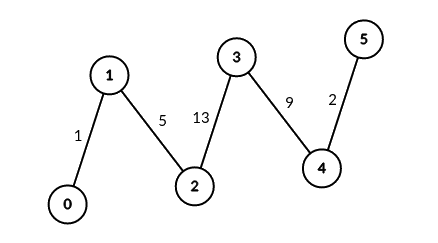
输入:edges = [[0,1,1],[1,2,5],[2,3,13],[3,4,9],[4,5,2]], signalSpeed = 1
输出:[0,4,6,6,4,0]
解释:由于 signalSpeed 等于 1 ,count[c] 等于所有从 c 开始且没有公共边的路径对数目。
在输入图中,count[c] 等于服务器 c 左边服务器数目乘以右边服务器数目。
示例 2:
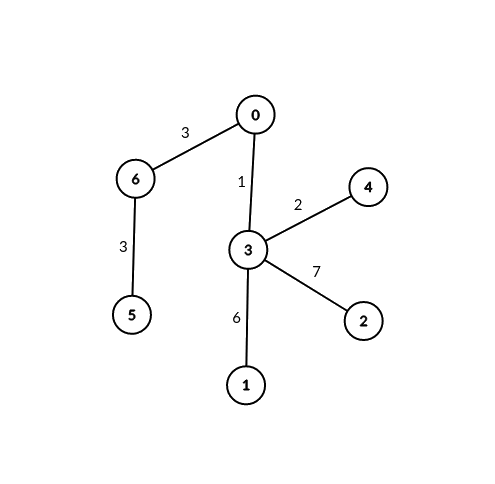
输入:edges = [[0,6,3],[6,5,3],[0,3,1],[3,2,7],[3,1,6],[3,4,2]], signalSpeed = 3
输出:[2,0,0,0,0,0,2]
解释:通过服务器 0 ,有 2 个可连接服务器对(4, 5) 和 (4, 6) 。
通过服务器 6 ,有 2 个可连接服务器对 (4, 5) 和 (0, 5) 。
所有服务器对都必须通过服务器 0 或 6 才可连接,所以其他服务器对应的可连接服务器对数目都为 0 。
提示:
2 <= n <= 1000edges.length == n - 1edges[i].length == 30 <= ai, bi < nedges[i] = [ai, bi, weighti]1 <= weighti <= 1061 <= signalSpeed <= 106- 输入保证
edges构成一棵合法的树。
解题思路
方法一:枚举 + DFS
我们先根据题目给定的边构建出一个邻接表 ,其中 表示节点 的所有邻居节点以及对应的边权。
然后,我们可以枚举每一个节点 作为连接的中间节点,通过深度优先搜索计算出从 的邻居节点 出发的,且到节点 的距离可以被 整除的节点数 。那么,节点 的可连接节点对数目增加了 ,其中 表示节点 的邻居节点 出发的,且到节点 的距离不可以被 整除的累计节点数。然后我们更新 为 。
枚举完所有节点 之后,我们就可以得到所有节点的可连接节点对数目。
时间复杂度 ,空间复杂度 。其中 表示节点数。
class Solution:
    def countPairsOfConnectableServers(
        self, edges: List[List[int]], signalSpeed: int
    ) -> List[int]:
        def dfs(a: int, fa: int, ws: int) -> int:
            cnt = 0 if ws % signalSpeed else 1
            for b, w in g[a]:
                if b != fa:
                    cnt += dfs(b, a, ws + w)
            return cnt

        n = len(edges) + 1
        g = [[] for _ in range(n)]
        for a, b, w in edges:
            g[a].append((b, w))
            g[b].append((a, w))
        ans = [0] * n
        for a in range(n):
            s = 0
            for b, w in g[a]:
                t = dfs(b, a, w)
                ans[a] += s * t
                s += t
        return ans
复杂度分析
| 指标 | 值 |
|---|---|
| 时间 | Depends on the final approach |
| 空间 | Depends on the final approach |
面试官常问的追问
外企场景- question_mark
Look for a solution that efficiently calculates connectable pairs using DFS traversal and subtree size tracking.
- question_mark
Candidates should demonstrate how they optimize the pair-counting process to avoid checking all possible pairs.
- question_mark
Be aware of the need to consider the signalSpeed constraint when connecting servers through intermediate nodes.
常见陷阱
外企场景- error
Forgetting to account for the signalSpeed when determining connectable pairs through each server.
- error
Inefficient pair counting that leads to excessive computation, especially for larger inputs.
- error
Not properly managing subtree size and distance calculations during the DFS, resulting in incorrect pair counts.
进阶变体
外企场景- arrow_right_alt
Handling cases where signalSpeed is very large or small compared to the tree's structure.
- arrow_right_alt
Exploring alternative methods for DFS traversal that avoid redundant calculations for each server.
- arrow_right_alt
Optimizing space complexity by reducing the need to store all distances or subtree sizes at once.