

LeetCode 题解工作台
统计包含每个点的矩形数目
给你一个二维整数数组 rectangles ,其中 rectangles[i] = [l i , h i ] 表示第 i 个矩形长为 l i 高为 h i 。给你一个二维整数数组 points ,其中 points[j] = [x j , y j ] 是坐标为 (x j , y j ) 的一个点。 …
5
题型
5
代码语言
3
相关题
当前训练重点
中等 · 数组·哈希·扫描
答案摘要
class Solution: def countRectangles(


Interview AiBoxInterview AiBox 实时 AI 助手,陪你讲清 数组·哈希·扫描 题型思路
题目描述
给你一个二维整数数组 rectangles ,其中 rectangles[i] = [li, hi] 表示第 i 个矩形长为 li 高为 hi 。给你一个二维整数数组 points ,其中 points[j] = [xj, yj] 是坐标为 (xj, yj) 的一个点。
第 i 个矩形的 左下角 在 (0, 0) 处,右上角 在 (li, hi) 。
请你返回一个整数数组 count ,长度为 points.length,其中 count[j]是 包含 第 j 个点的矩形数目。
如果 0 <= xj <= li 且 0 <= yj <= hi ,那么我们说第 i 个矩形包含第 j 个点。如果一个点刚好在矩形的 边上 ,这个点也被视为被矩形包含。
示例 1:
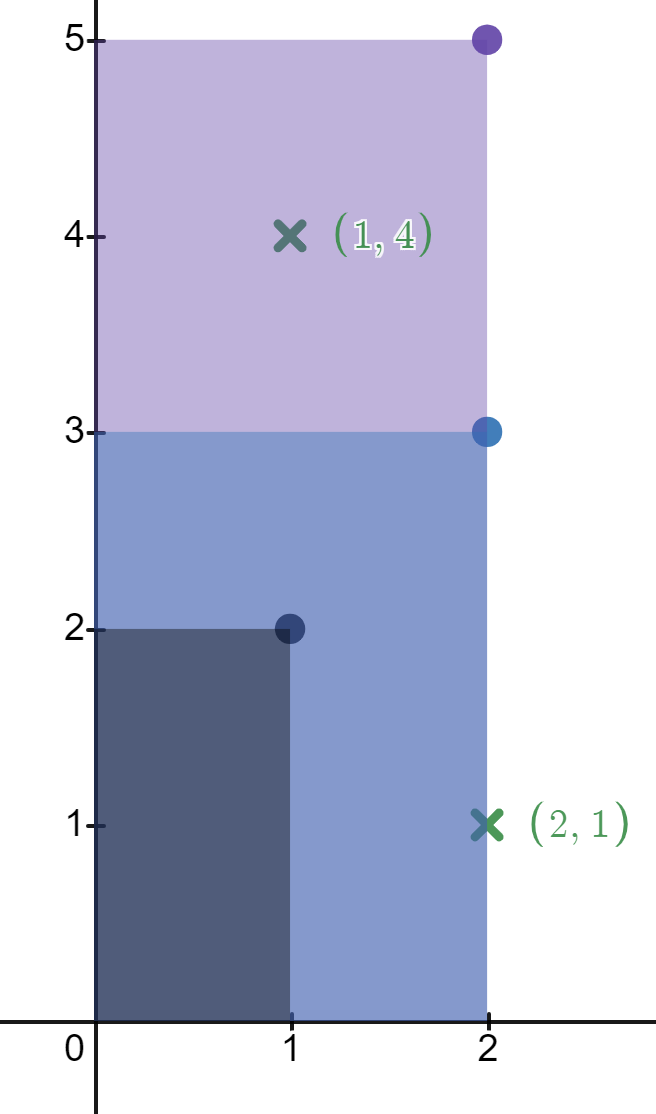
输入:rectangles = [[1,2],[2,3],[2,5]], points = [[2,1],[1,4]]
输出:[2,1]
解释:
第一个矩形不包含任何点。
第二个矩形只包含一个点 (2, 1) 。
第三个矩形包含点 (2, 1) 和 (1, 4) 。
包含点 (2, 1) 的矩形数目为 2 。
包含点 (1, 4) 的矩形数目为 1 。
所以,我们返回 [2, 1] 。
示例 2:
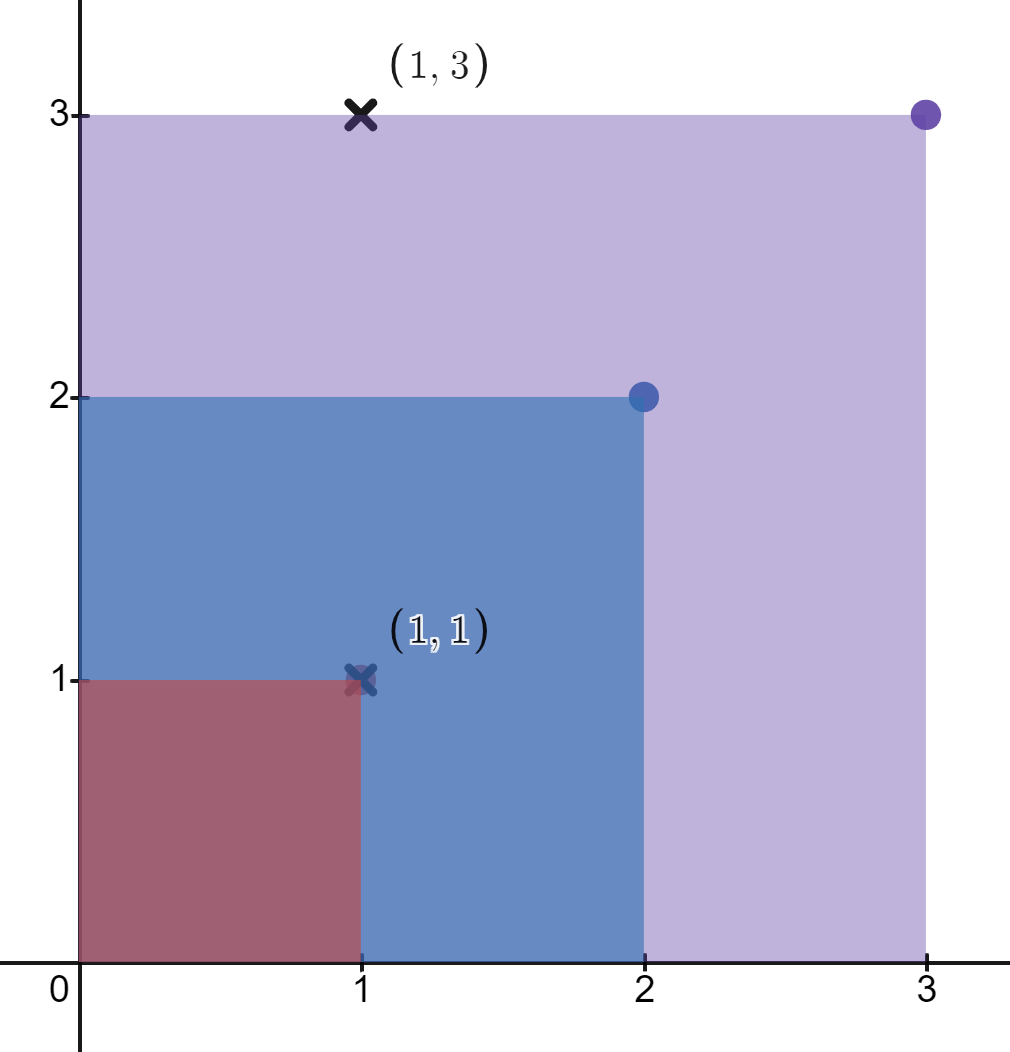
输入:rectangles = [[1,1],[2,2],[3,3]], points = [[1,3],[1,1]]
输出:[1,3]
解释:
第一个矩形只包含点 (1, 1) 。
第二个矩形只包含点 (1, 1) 。
第三个矩形包含点 (1, 3) 和 (1, 1) 。
包含点 (1, 3) 的矩形数目为 1 。
包含点 (1, 1) 的矩形数目为 3 。
所以,我们返回 [1, 3] 。
提示:
1 <= rectangles.length, points.length <= 5 * 104rectangles[i].length == points[j].length == 21 <= li, xj <= 1091 <= hi, yj <= 100- 所有
rectangles互不相同 。 - 所有
points互不相同 。
解题思路
方法一:排序 + 二分
class Solution:
    def countRectangles(
        self, rectangles: List[List[int]], points: List[List[int]]
    ) -> List[int]:
        d = defaultdict(list)
        for x, y in rectangles:
            d[y].append(x)
        for y in d.keys():
            d[y].sort()
        ans = []
        for x, y in points:
            cnt = 0
            for h in range(y, 101):
                xs = d[h]
                cnt += len(xs) - bisect_left(xs, x)
            ans.append(cnt)
        return ans
复杂度分析
| 指标 | 值 |
|---|---|
| 时间 | complexity depends on the approach chosen. The brute force solution involves checking every point against all rectangles, leading to O(N*M) complexity, where N is the number of rectangles and M is the number of points. Optimizations such as binary search or pre-computation can reduce this. Space complexity also depends on the approach, with storage for rectangles and points taking O(N + M) space in the worst case. |
| 空间 | Depends on the final approach |
面试官常问的追问
外企场景- question_mark
Candidate's ability to optimize brute force methods for large inputs.
- question_mark
Awareness of sorting and binary search optimization techniques.
- question_mark
Understanding of hash table usage for efficient lookup and pre-computation.
常见陷阱
外企场景- error
Incorrectly assuming all rectangles are relevant for each point, leading to excessive checks.
- error
Failure to optimize searching for rectangles by overlooking sorting or binary search options.
- error
Not considering space and time trade-offs when scaling to the upper constraint limits.
进阶变体
外企场景- arrow_right_alt
What if rectangles or points had larger or smaller values?
- arrow_right_alt
How would the problem change if rectangles were not guaranteed to have unique dimensions?
- arrow_right_alt
How can we modify this approach to handle a dynamically changing set of rectangles or points?