

LeetCode 题解工作台
网络信号最好的坐标
给你一个数组 towers 和一个整数 radius 。 数组 towers 中包含一些网络信号塔,其中 towers[i] = [x i , y i , q i ] 表示第 i 个网络信号塔的坐标是 (x i , y i ) 且信号强度参数为 q i 。所有坐标都是在 X-Y 坐标系内的 整数 坐…
2
题型
4
代码语言
3
相关题
当前训练重点
中等 · 数组·结合·enumeration
答案摘要
由于坐标点的范围是 $[0,.. 50]$,因此我们可以直接暴力枚举所有的坐标点 $(i, j)$,计算每个坐标点的信号强度,然后找出信号强度最大的坐标点。 时间复杂度 $O(n \times C^2)$,其中 是信号塔的数量,而 是坐标点的范围大小。


Interview AiBoxInterview AiBox 实时 AI 助手,陪你讲清 数组·结合·enumeration 题型思路
题目描述
给你一个数组 towers 和一个整数 radius 。
数组 towers 中包含一些网络信号塔,其中 towers[i] = [xi, yi, qi] 表示第 i 个网络信号塔的坐标是 (xi, yi) 且信号强度参数为 qi 。所有坐标都是在 X-Y 坐标系内的 整数 坐标。两个坐标之间的距离用 欧几里得距离 计算。
整数 radius 表示一个塔 能到达 的 最远距离 。如果一个坐标跟塔的距离在 radius 以内,那么该塔的信号可以到达该坐标。在这个范围以外信号会很微弱,所以 radius 以外的距离该塔是 不能到达的 。
如果第 i 个塔能到达 (x, y) ,那么该塔在此处的信号为 ⌊qi / (1 + d)⌋ ,其中 d 是塔跟此坐标的距离。一个坐标的 信号强度 是所有 能到达 该坐标的塔的信号强度之和。
请你返回数组 [cx, cy] ,表示 信号强度 最大的 整数 坐标点 (cx, cy) 。如果有多个坐标网络信号一样大,请你返回字典序最小的 非负 坐标。
注意:
- 坐标
(x1, y1)字典序比另一个坐标(x2, y2)小,需满足以下条件之一:- 要么
x1 < x2, - 要么
x1 == x2且y1 < y2。
- 要么
⌊val⌋表示小于等于val的最大整数(向下取整函数)。
示例 1:
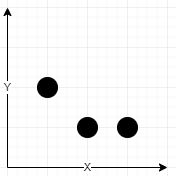
输入:towers = [[1,2,5],[2,1,7],[3,1,9]], radius = 2
输出:[2,1]
解释:
坐标 (2, 1) 信号强度之和为 13
- 塔 (2, 1) 强度参数为 7 ,在该点强度为 ⌊7 / (1 + sqrt(0)⌋ = ⌊7⌋ = 7
- 塔 (1, 2) 强度参数为 5 ,在该点强度为 ⌊5 / (1 + sqrt(2)⌋ = ⌊2.07⌋ = 2
- 塔 (3, 1) 强度参数为 9 ,在该点强度为 ⌊9 / (1 + sqrt(1)⌋ = ⌊4.5⌋ = 4
没有别的坐标有更大的信号强度。
示例 2:
输入:towers = [[23,11,21]], radius = 9
输出:[23,11]
解释:由于仅存在一座信号塔,所以塔的位置信号强度最大。
示例 3:
输入:towers = [[1,2,13],[2,1,7],[0,1,9]], radius = 2
输出:[1,2]
解释:坐标 (1, 2) 的信号强度最大。
提示:
1 <= towers.length <= 50towers[i].length == 30 <= xi, yi, qi <= 501 <= radius <= 50
解题思路
方法一:暴力枚举
由于坐标点的范围是 ,因此我们可以直接暴力枚举所有的坐标点 ,计算每个坐标点的信号强度,然后找出信号强度最大的坐标点。
时间复杂度 ,其中 是信号塔的数量,而 是坐标点的范围大小。
class Solution:
    def bestCoordinate(self, towers: List[List[int]], radius: int) -> List[int]:
        mx = 0
        ans = [0, 0]
        for i in range(51):
            for j in range(51):
                t = 0
                for x, y, q in towers:
                    d = ((x - i) ** 2 + (y - j) ** 2) ** 0.5
                    if d <= radius:
                        t += floor(q / (1 + d))
                if t > mx:
                    mx = t
                    ans = [i, j]
        return ans
复杂度分析
| 指标 | 值 |
|---|---|
| 时间 | complexity is O((maxX*maxY)*n) where maxX and maxY are the maximum coordinates and n is the number of towers, since each coordinate may check every tower. Space complexity is O(1) extra beyond input, though temporary storage for distances or maximum tracking is constant. |
| 空间 | Depends on the final approach |
面试官常问的追问
外企场景- question_mark
Watch for missing tie-breaking when multiple coordinates have the same network quality.
- question_mark
Confirm that signal calculations use integer division as specified by ⌊qi / (1 + distance)⌋.
- question_mark
Expect discussion on whether iterating all coordinates is feasible under small constraints.
常见陷阱
外企场景- error
Forgetting the radius cutoff, leading to including towers beyond reach.
- error
Miscomputing Euclidean distance or applying floating-point division incorrectly.
- error
Ignoring tie-breaking rules for X and Y when multiple coordinates yield the same quality.
进阶变体
外企场景- arrow_right_alt
Maximize network quality with non-integral coordinates, requiring more precise distance handling.
- arrow_right_alt
Include signal decay factors or weights per tower, adding complexity to the sum computation.
- arrow_right_alt
Compute top k coordinates with highest network quality instead of just the maximum.