

LeetCode 题解工作台
球会落何处
用一个大小为 m x n 的二维网格 grid 表示一个箱子。你有 n 颗球。箱子的顶部和底部都是开着的。 箱子中的每个单元格都有一个对角线挡板,跨过单元格的两个角,可以将球导向左侧或者右侧。 将球导向右侧的挡板跨过左上角和右下角,在网格中用 1 表示。 将球导向左侧的挡板跨过右上角和左下角,在网格…
3
题型
7
代码语言
3
相关题
当前训练重点
中等 · 数组·matrix
答案摘要
我们可以使用 DFS 来模拟球的运动过程,设计一个函数 $\textit{dfs}(i, j)$,表示球从第 行第 列出发,最终会落在第几列。对于以下情况,球会卡住: 1. 球位于最左一列,并且球所在的单元格单元格挡板将球导向左侧


Interview AiBoxInterview AiBox 实时 AI 助手,陪你讲清 数组·matrix 题型思路
题目描述
用一个大小为 m x n 的二维网格 grid 表示一个箱子。你有 n 颗球。箱子的顶部和底部都是开着的。
箱子中的每个单元格都有一个对角线挡板,跨过单元格的两个角,可以将球导向左侧或者右侧。
- 将球导向右侧的挡板跨过左上角和右下角,在网格中用
1表示。 - 将球导向左侧的挡板跨过右上角和左下角,在网格中用
-1表示。
在箱子每一列的顶端各放一颗球。每颗球都可能卡在箱子里或从底部掉出来。如果球恰好卡在两块挡板之间的 "V" 形图案,或者被一块挡导向到箱子的任意一侧边上,就会卡住。
返回一个大小为 n 的数组 answer ,其中 answer[i] 是球放在顶部的第 i 列后从底部掉出来的那一列对应的下标,如果球卡在盒子里,则返回 -1 。
示例 1:
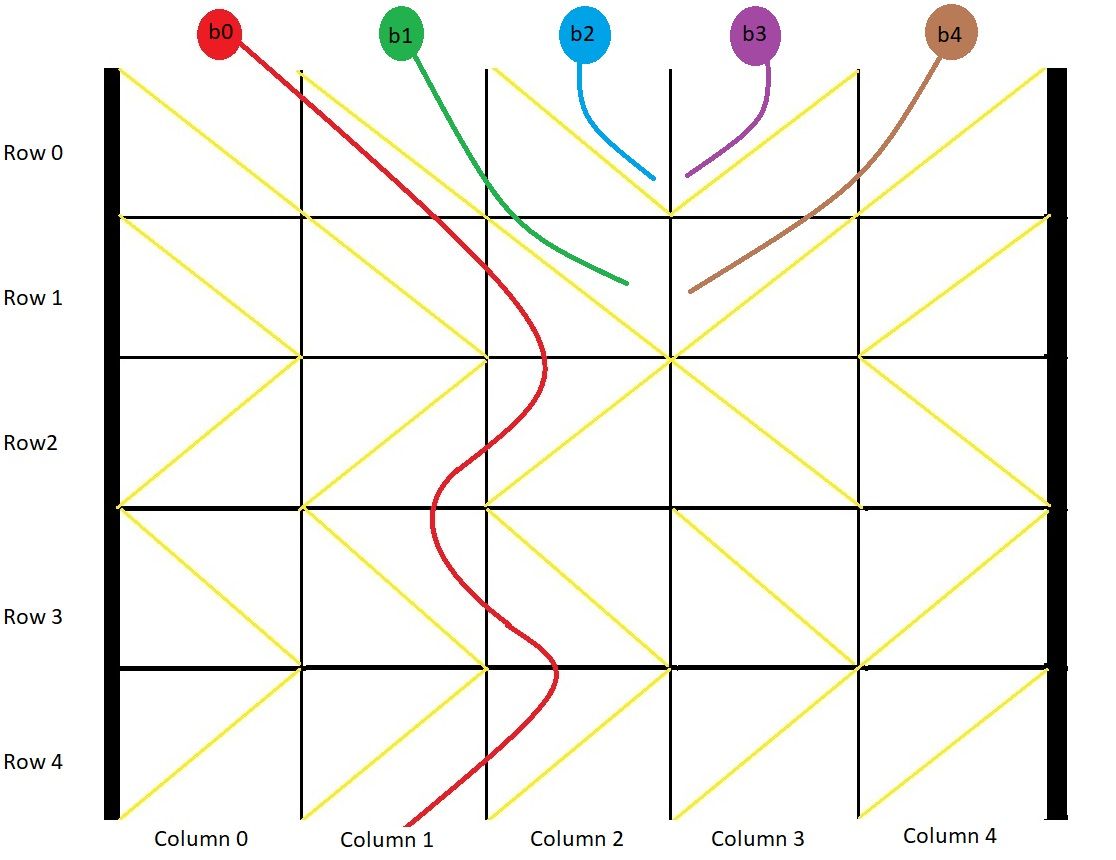
输入:grid = [[1,1,1,-1,-1],[1,1,1,-1,-1],[-1,-1,-1,1,1],[1,1,1,1,-1],[-1,-1,-1,-1,-1]]
输出:[1,-1,-1,-1,-1]
解释:示例如图:
b0 球开始放在第 0 列上,最终从箱子底部第 1 列掉出。
b1 球开始放在第 1 列上,会卡在第 2、3 列和第 1 行之间的 "V" 形里。
b2 球开始放在第 2 列上,会卡在第 2、3 列和第 0 行之间的 "V" 形里。
b3 球开始放在第 3 列上,会卡在第 2、3 列和第 0 行之间的 "V" 形里。
b4 球开始放在第 4 列上,会卡在第 2、3 列和第 1 行之间的 "V" 形里。
示例 2:
输入:grid = [[-1]]
输出:[-1]
解释:球被卡在箱子左侧边上。
示例 3:
输入:grid = [[1,1,1,1,1,1],[-1,-1,-1,-1,-1,-1],[1,1,1,1,1,1],[-1,-1,-1,-1,-1,-1]]
输出:[0,1,2,3,4,-1]
提示:
m == grid.lengthn == grid[i].length1 <= m, n <= 100grid[i][j]为1或-1
解题思路
方法一:分情况讨论 + DFS
我们可以使用 DFS 来模拟球的运动过程,设计一个函数 ,表示球从第 行第 列出发,最终会落在第几列。对于以下情况,球会卡住:
- 球位于最左一列,并且球所在的单元格单元格挡板将球导向左侧
- 球位于最右一列,并且此单元格挡板将球导向右侧
- 球所在的单元格挡板将球导向右侧,并且球右侧相邻单元格挡板将球导向左侧
- 球所在的单元格挡板将球导向左侧,并且球左侧相邻单元格挡板将球导向右侧
如果满足以上任意一种情况,我们就可以判断球会卡住,返回 。否则,我们就可以继续递归地寻找球的下一个位置。最后,如果球到了最后一行,我们就可以返回当前列的编号。
时间复杂度 ,空间复杂度 。其中 和 分别是数组 的行数和列数。
class Solution:
    def findBall(self, grid: List[List[int]]) -> List[int]:
        def dfs(i: int, j: int) -> int:
            if i == m:
                return j
            if j == 0 and grid[i][j] == -1:
                return -1
            if j == n - 1 and grid[i][j] == 1:
                return -1
            if grid[i][j] == 1 and grid[i][j + 1] == -1:
                return -1
            if grid[i][j] == -1 and grid[i][j - 1] == 1:
                return -1
            return dfs(i + 1, j + 1) if grid[i][j] == 1 else dfs(i + 1, j - 1)

        m, n = len(grid), len(grid[0])
        return [dfs(0, j) for j in range(n)]
复杂度分析
| 指标 | 值 |
|---|---|
| 时间 | complexity is O(m * n) since each ball may traverse all rows in its column. Space complexity is O(n) for storing the output array, or O(m) additional if using recursion in DFS for path tracking. |
| 空间 | Depends on the final approach |
面试官常问的追问
外企场景- question_mark
Notice each ball moves independently through the grid; look for per-column simulation patterns.
- question_mark
Pay attention to the 'V' shaped stuck condition formed by adjacent cells and edge cases on walls.
- question_mark
Consider iterative versus recursive approaches to clearly handle ball paths and stuck detection.
常见陷阱
外企场景- error
Forgetting to check the 'V' shaped block between two adjacent boards leading to incorrect stuck results.
- error
Ignoring wall boundaries causing array index errors or wrong exit positions.
- error
Mixing row and column indices, which can misdirect the ball in the simulation.
进阶变体
外企场景- arrow_right_alt
Return only the count of balls that successfully exit rather than their positions.
- arrow_right_alt
Allow arbitrary board angles represented by integers beyond 1 and -1, requiring generalized movement rules.
- arrow_right_alt
Simulate gravity in reverse from bottom to top to compute reachable top columns.