

LeetCode 题解工作台
模拟行走机器人 II
给你一个在 XY 平面上的 width x height 的网格图, 左下角 的格子为 (0, 0) , 右上角 的格子为 (width - 1, height - 1) 。网格图中相邻格子为四个基本方向之一( "North" , "East" , "South" 和 "West" )。一个机器人 …
2
题型
5
代码语言
3
相关题
当前训练重点
中等 · design·结合·模拟
答案摘要
我们记 $mx = width - 1$ 和 $my = height - 1$,则机器人的运动轨迹是一个以 $(0, 0)$ 为左下角,而 $(mx, my)$ 为右上角的矩形的边界。我们可以将机器人的运动轨迹分为四段: 1. 从 $(0, 0)$ 沿着 轴正方向运动到 $(mx, 0)$,此时机器人的朝向为 "East"。


Interview AiBoxInterview AiBox 实时 AI 助手,陪你讲清 design·结合·模拟 题型思路
题目描述
给你一个在 XY 平面上的 width x height 的网格图,左下角 的格子为 (0, 0) ,右上角 的格子为 (width - 1, height - 1) 。网格图中相邻格子为四个基本方向之一("North","East","South" 和 "West")。一个机器人 初始 在格子 (0, 0) ,方向为 "East" 。
机器人可以根据指令移动指定的 步数 。每一步,它可以执行以下操作。
- 沿着当前方向尝试 往前一步 。
- 如果机器人下一步将到达的格子 超出了边界 ,机器人会 逆时针 转 90 度,然后再尝试往前一步。
如果机器人完成了指令要求的移动步数,它将停止移动并等待下一个指令。
请你实现 Robot 类:
Robot(int width, int height)初始化一个width x height的网格图,机器人初始在(0, 0),方向朝"East"。void step(int num)给机器人下达前进num步的指令。int[] getPos()返回机器人当前所处的格子位置,用一个长度为 2 的数组[x, y]表示。String getDir()返回当前机器人的朝向,为"North","East","South"或者"West"。
示例 1:
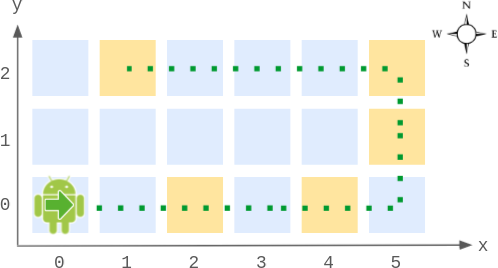
输入:
["Robot", "step", "step", "getPos", "getDir", "step", "step", "step", "getPos", "getDir"]
[[6, 3], [2], [2], [], [], [2], [1], [4], [], []]
输出:
[null, null, null, [4, 0], "East", null, null, null, [1, 2], "West"]

解释:
Robot robot = new Robot(6, 3); // 初始化网格图,机器人在 (0, 0) ,朝东。
robot.step(2);  // 机器人朝东移动 2 步,到达 (2, 0) ,并朝东。
robot.step(2);  // 机器人朝东移动 2 步,到达 (4, 0) ,并朝东。
robot.getPos(); // 返回 [4, 0]
robot.getDir(); // 返回 "East"
robot.step(2);  // 朝东移动 1 步到达 (5, 0) ,并朝东。
                // 下一步继续往东移动将出界,所以逆时针转变方向朝北。
                // 然后,往北移动 1 步到达 (5, 1) ,并朝北。
robot.step(1);  // 朝北移动 1 步到达 (5, 2) ,并朝 北 (不是朝西)。
robot.step(4);  // 下一步继续往北移动将出界,所以逆时针转变方向朝西。
                // 然后,移动 4 步到 (1, 2) ,并朝西。
robot.getPos(); // 返回 [1, 2]
robot.getDir(); // 返回 "West"
提示:
2 <= width, height <= 1001 <= num <= 105step,getPos和getDir总共 调用次数不超过104次。
解题思路
方法一:分类讨论
我们记 和 ,则机器人的运动轨迹是一个以 为左下角,而 为右上角的矩形的边界。我们可以将机器人的运动轨迹分为四段:
- 从 沿着 轴正方向运动到 ,此时机器人的朝向为 "East"。
- 从 沿着 轴正方向运动到 ,此时机器人的朝向为 "North"。
- 从 沿着 轴负方向运动到 ,此时机器人的朝向为 "West"。
- 从 沿着 轴负方向运动到 ,此时机器人的朝向为 "South"。
因此,我们可以将机器人的运动轨迹看作是一个长度为 的循环。对于每次调用 step(num),我们可以将机器人的当前位置加上 num,然后对 取模,得到机器人的新位置。根据机器人的新位置,我们可以判断出机器人的朝向和坐标。
注意,如果机器人没有移动过,那么它的朝向应该是 "East"。如果机器人移动过,且位置为 ,则机器人的朝向应该是 "South"。
时间复杂度 ,空间复杂度 。
class Robot:

    def __init__(self, width: int, height: int):
        self.mx = width - 1
        self.my = height - 1
        self.p = 2 * self.mx + 2 * self.my
        self.cur = 0
        self.moved = False

    def step(self, num: int) -> None:
        self.moved = True
        self.cur = (self.cur + num) % self.p

    def getPos(self) -> List[int]:
        d = self.cur
        mx, my = self.mx, self.my
        if 0 <= d <= mx:
            return [d, 0]
        if mx < d <= mx + my:
            return [mx, d - mx]
        if mx + my < d <= 2 * mx + my:
            return [mx - (d - (mx + my)), my]
        return [0, my - (d - (2 * mx + my))]

    def getDir(self) -> str:
        d = self.cur
        mx, my = self.mx, self.my
        if not self.moved:
            return "East"
        if 1 <= d <= mx:
            return "East"
        elif mx < d <= mx + my:
            return "North"
        elif mx + my < d <= 2 * mx + my:
            return "West"
        return "South"


# Your Robot object will be instantiated and called as such:
# obj = Robot(width, height)
# obj.step(num)
# param_2 = obj.getPos()
# param_3 = obj.getDir()
复杂度分析
| 指标 | 值 |
|---|---|
| 时间 | Depends on the final approach |
| 空间 | Depends on the final approach |
面试官常问的追问
外企场景- question_mark
Looking for a clean approach to handle boundary conditions and direction changes.
- question_mark
Check if the candidate can optimize the position tracking with modulus for wrapping around the grid.
- question_mark
Evaluate the candidate’s ability to simulate multiple commands without unnecessary complexity.
常见陷阱
外企场景- error
Not handling the boundary conditions properly, causing the robot to move out of bounds.
- error
Overcomplicating the direction changes, leading to inefficient code.
- error
Failing to correctly update the robot’s state after each command.
进阶变体
外企场景- arrow_right_alt
Add more complex movement patterns with obstacles in the grid.
- arrow_right_alt
Simulate robot movements in a 3D grid or more complex environments.
- arrow_right_alt
Introduce time-based movements, where the robot’s speed varies depending on the command.