

LeetCode 题解工作台
蜗牛排序
请你编写一段代码为所有数组实现 snail(rowsCount,colsCount) 方法,该方法将 1D 数组转换为以蜗牛排序的模式的 2D 数组。无效的输入值应该输出一个空数组。当 rowsCount * colsCount !== nums.length 时。这个输入被认为是无效的。 蜗牛排序…
0
题型
1
代码语言
0
相关题
当前训练重点
中等 · Snail Traversal core interview pattern
答案摘要
我们首先判断数组的长度是否等于行数与列数的乘积,如果不等,说明输入是无效的,返回空数组。 接下来,我们可以模拟蜗牛排序的过程,从左上角开始,遍历数组,按照蜗牛排序的顺序,将遍历到的元素依次放入结果数组中。


Interview AiBoxInterview AiBox 实时 AI 助手,陪你讲清 Snail Traversal core interview pattern 题型思路
题目描述
请你编写一段代码为所有数组实现 snail(rowsCount,colsCount) 方法,该方法将 1D 数组转换为以蜗牛排序的模式的 2D 数组。无效的输入值应该输出一个空数组。当 rowsCount * colsCount !==nums.length 时。这个输入被认为是无效的。
蜗牛排序从左上角的单元格开始,从当前数组的第一个值开始。然后,它从上到下遍历第一列,接着移动到右边的下一列,并从下到上遍历它。将这种模式持续下去,每列交替变换遍历方向,直到覆盖整个数组。例如,当给定输入数组 [19, 10, 3, 7, 9, 8, 5, 2, 1, 17, 16, 14, 12, 18, 6, 13, 11, 20, 4, 15] ,当 rowsCount = 5 且 colsCount = 4 时,需要输出矩阵如下图所示。注意,矩阵沿箭头方向对应于原数组中数字的顺序
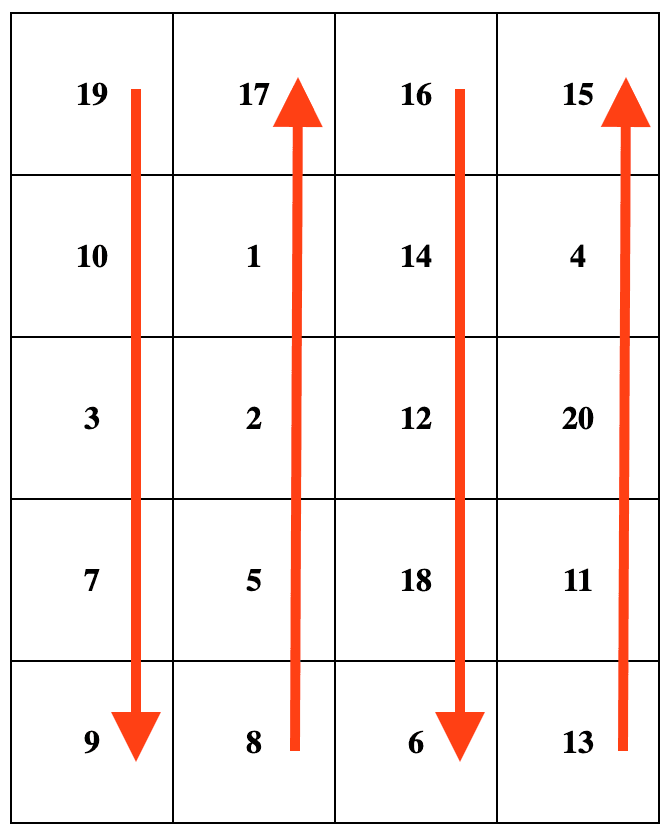
示例 1:
输入:
nums = [19, 10, 3, 7, 9, 8, 5, 2, 1, 17, 16, 14, 12, 18, 6, 13, 11, 20, 4, 15]
rowsCount = 5
colsCount = 4
输出:
[
 [19,17,16,15],
 [10,1,14,4],
 [3,2,12,20],
 [7,5,18,11],
 [9,8,6,13]
]
示例 2:
输入:
nums = [1,2,3,4]
rowsCount = 1
colsCount = 4
输出:[[1, 2, 3, 4]]
示例 3:
输入:
nums = [1,3]
rowsCount = 2
colsCount = 2
输出:[]
Explanation: 2 * 2 = 4, 且原数组 [1,3] 的长度为 2; 所以,输入是无效的。
提示:
0 <= nums.length <= 2501 <= nums[i] <= 10001 <= rowsCount <= 2501 <= colsCount <= 250
解题思路
方法一:模拟
我们首先判断数组的长度是否等于行数与列数的乘积,如果不等,说明输入是无效的,返回空数组。
接下来,我们可以模拟蜗牛排序的过程,从左上角开始,遍历数组,按照蜗牛排序的顺序,将遍历到的元素依次放入结果数组中。
时间复杂度 ,其中 为数组的长度。忽略答案数组的空间消耗,空间复杂度 。
declare global {
    interface Array<T> {
        snail(rowsCount: number, colsCount: number): number[][];
    }
}

Array.prototype.snail = function (rowsCount: number, colsCount: number): number[][] {
    if (rowsCount * colsCount !== this.length) {
        return [];
    }
    const ans: number[][] = Array.from({ length: rowsCount }, () => Array(colsCount));
    for (let h = 0, i = 0, j = 0, k = 1; h < this.length; ++h) {
        ans[i][j] = this[h];
        i += k;
        if (i === rowsCount || i === -1) {
            i -= k;
            k = -k;
            ++j;
        }
    }
    return ans;
};

/**
 * const arr = [1,2,3,4];
 * arr.snail(1,4); // [[1,2,3,4]]
 */
复杂度分析
| 指标 | 值 |
|---|---|
| 时间 | complexity is O(N) because every element is visited once. Space complexity is O(N) due to the resulting 2D array holding all elements from the original array. |
| 空间 | O(N) |
面试官常问的追问
外企场景- question_mark
Ask about handling invalid input arrays that do not match rowsCount * colsCount.
- question_mark
Check if the candidate correctly alternates column directions for snail traversal.
- question_mark
Expect discussion on efficient O(N) column-wise filling without redundant operations.
常见陷阱
外企场景- error
Not validating the input length before constructing the matrix.
- error
Filling all columns in the same direction, breaking the snail pattern.
- error
Incorrectly computing row indices for bottom-to-top traversal.
进阶变体
外企场景- arrow_right_alt
Snail traversal row-wise instead of column-wise with alternating directions.
- arrow_right_alt
Generating the traversal order as a flat 1D output instead of a 2D matrix.
- arrow_right_alt
Handling dynamic resizing or non-rectangular matrices with padding.