

LeetCode 题解工作台
冗余连接 II
在本问题中,有根树指满足以下条件的 有向 图。该树只有一个根节点,所有其他节点都是该根节点的后继。该树除了根节点之外的每一个节点都有且只有一个父节点,而根节点没有父节点。 输入一个有向图,该图由一个有着 n 个节点(节点值不重复,从 1 到 n )的树及一条附加的有向边构成。附加的边包含在 1 到 …
4
题型
6
代码语言
3
相关题
当前训练重点
困难 · 图·DFS·traversal
答案摘要
根据题目描述,对于一棵有根树,根节点的入度为 ,其余节点的入度为 。在向树中添加一条边之后,可能会出现以下三种情况: 1. 添加的边指向了非根节点,该节点的入度变为 ,此时图中不存在有向环;


Interview AiBoxInterview AiBox 实时 AI 助手,陪你讲清 图·DFS·traversal 题型思路
题目描述
在本问题中,有根树指满足以下条件的 有向 图。该树只有一个根节点,所有其他节点都是该根节点的后继。该树除了根节点之外的每一个节点都有且只有一个父节点,而根节点没有父节点。
输入一个有向图,该图由一个有着 n 个节点(节点值不重复,从 1 到 n)的树及一条附加的有向边构成。附加的边包含在 1 到 n 中的两个不同顶点间,这条附加的边不属于树中已存在的边。
结果图是一个以边组成的二维数组 edges 。 每个元素是一对 [ui, vi],用以表示 有向 图中连接顶点 ui 和顶点 vi 的边,其中 ui 是 vi 的一个父节点。
返回一条能删除的边,使得剩下的图是有 n 个节点的有根树。若有多个答案,返回最后出现在给定二维数组的答案。
示例 1:
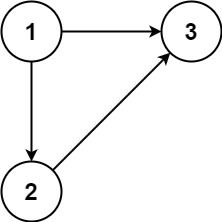
输入:edges = [[1,2],[1,3],[2,3]]
输出:[2,3]
示例 2:
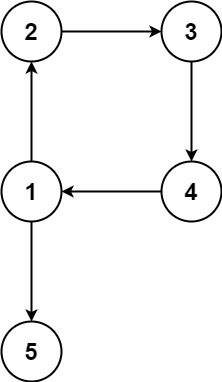
输入:edges = [[1,2],[2,3],[3,4],[4,1],[1,5]]
输出:[4,1]
提示:
n == edges.length3 <= n <= 1000edges[i].length == 21 <= ui, vi <= n
解题思路
方法一:并查集
根据题目描述,对于一棵有根树,根节点的入度为 ,其余节点的入度为 。在向树中添加一条边之后,可能会出现以下三种情况:
-
添加的边指向了非根节点,该节点的入度变为 ,此时图中不存在有向环;
1 / \ v v 2-->3 -
添加的边指向了非根节点,该节点的入度变为 ,此时图中存在有向环;
1 | v 2 <--> 3 -
添加的边指向了根节点,根节点的入度变为 ,此时图中存在有向环,但不存在入度为 的节点。
    1
    /^
   v  \
   2-->3
因此,我们首先计算每个节点的入度,如果存在入度为 的节点,我们定位到该节点对应的两条边,分别记为 和 。如果在删除 之后,剩余的边无法形成树,则说明 是需要删除的边;否则 是需要删除的边。
如果不存在入度为 的节点,我们遍历数组 ,对于每条边 ,我们使用并查集维护节点之间的连通性。如果 和 已经连通,说明图中存在有向环,此时当前边即为需要删除的边。
时间复杂度 ,空间复杂度 。其中 为边的数量。
class Solution:
    def findRedundantDirectedConnection(self, edges: List[List[int]]) -> List[int]:
        def find(x: int) -> int:
            if p[x] != x:
                p[x] = find(p[x])
            return p[x]

        n = len(edges)
        ind = [0] * n
        for _, v in edges:
            ind[v - 1] += 1
        dup = [i for i, (_, v) in enumerate(edges) if ind[v - 1] == 2]
        p = list(range(n))
        if dup:
            for i, (u, v) in enumerate(edges):
                if i == dup[1]:
                    continue
                pu, pv = find(u - 1), find(v - 1)
                if pu == pv:
                    return edges[dup[0]]
                p[pu] = pv
            return edges[dup[1]]
        for i, (u, v) in enumerate(edges):
            pu, pv = find(u - 1), find(v - 1)
            if pu == pv:
                return edges[i]
            p[pu] = pv
复杂度分析
| 指标 | 值 |
|---|---|
| 时间 | O(N) |
| 空间 | O(N) |
面试官常问的追问
外企场景- question_mark
The candidate uses an efficient cycle detection algorithm like DFS or Union-Find.
- question_mark
The candidate is able to explain the graph traversal approach clearly and apply it correctly.
- question_mark
The candidate identifies and removes the redundant edge without unnecessary computation.
常见陷阱
外企场景- error
Not properly tracking the visited nodes, leading to incorrect cycle detection.
- error
Confusing Union-Find operations, such as not correctly implementing union and find operations.
- error
Failing to handle edge cases where the graph has only a single redundant connection.
进阶变体
外企场景- arrow_right_alt
Graph with multiple redundant edges (not allowed in this problem but can be extended to handle).
- arrow_right_alt
Using BFS instead of DFS for traversal and cycle detection.
- arrow_right_alt
Handling larger graphs with optimizations in both space and time complexity.