

LeetCode 题解工作台
细分图中的可到达节点
给你一个无向图( 原始图 ),图中有 n 个节点,编号从 0 到 n - 1 。你决定将图中的每条边 细分 为一条节点链,每条边之间的新节点数各不相同。 图用由边组成的二维数组 edges 表示,其中 edges[i] = [u i , v i , cnt i ] 表示原始图中节点 u i 和 v …
3
题型
4
代码语言
3
相关题
当前训练重点
困难 · 堆
答案摘要
这道题本质是求从节点 出发,最多经过 步,可以到达多少个节点。单源最短路,且边权非负,我们可以考虑使用 Dijkstra 算法。 根据题目描述,节点 到节点 之间存在 个新节点,那么节点 到节点 的距离为 $cnt_i + 1$。


Interview AiBoxInterview AiBox 实时 AI 助手,陪你讲清 堆 题型思路
题目描述
给你一个无向图(原始图),图中有 n 个节点,编号从 0 到 n - 1 。你决定将图中的每条边 细分 为一条节点链,每条边之间的新节点数各不相同。
图用由边组成的二维数组 edges 表示,其中 edges[i] = [ui, vi, cnti] 表示原始图中节点 ui 和 vi 之间存在一条边,cnti 是将边 细分 后的新节点总数。注意,cnti == 0 表示边不可细分。
要 细分 边 [ui, vi] ,需要将其替换为 (cnti + 1) 条新边,和 cnti 个新节点。新节点为 x1, x2, ..., xcnti ,新边为 [ui, x1], [x1, x2], [x2, x3], ..., [xcnti-1, xcnti], [xcnti, vi] 。
现在得到一个 新的细分图 ,请你计算从节点 0 出发,可以到达多少个节点?如果节点间距离是 maxMoves 或更少,则视为 可以到达 。
给你原始图和 maxMoves ,返回 新的细分图中从节点 0 出发 可到达的节点数 。
示例 1:
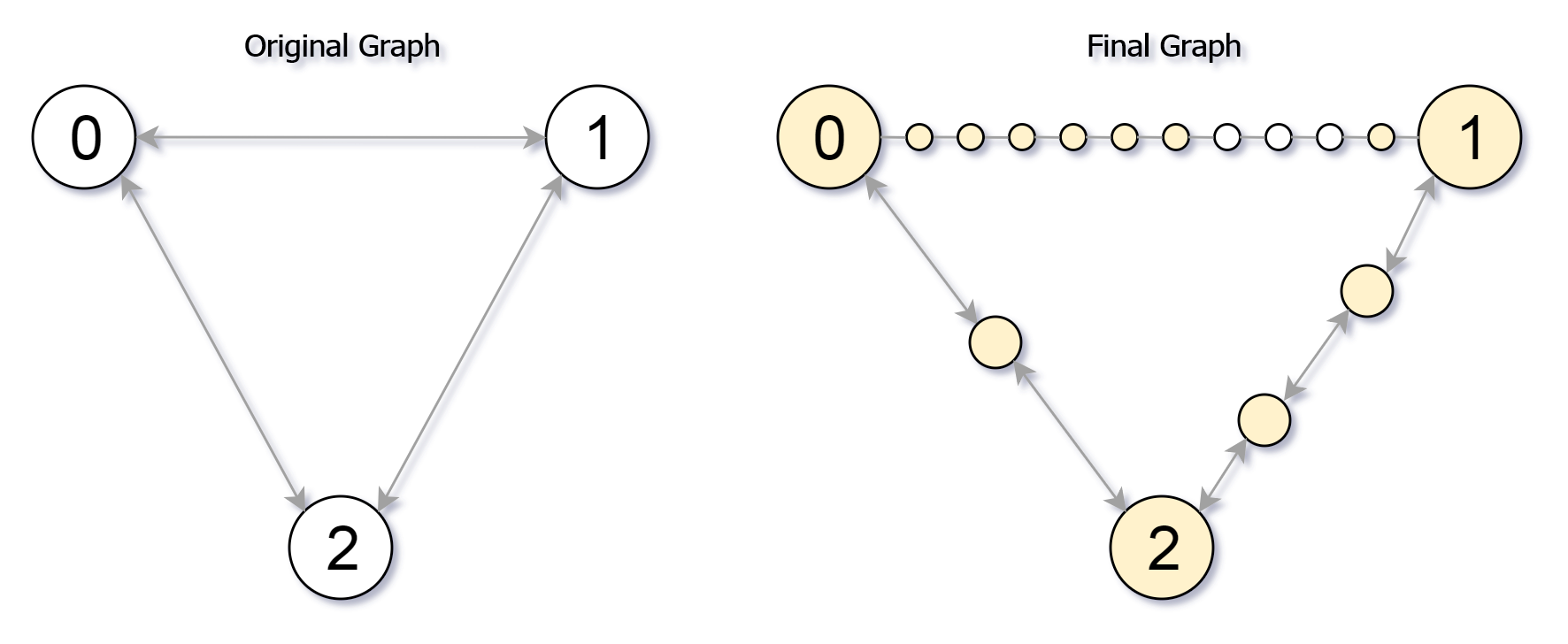
输入:edges = [[0,1,10],[0,2,1],[1,2,2]], maxMoves = 6, n = 3
输出:13
解释:边的细分情况如上图所示。
可以到达的节点已经用黄色标注出来。
示例 2:
输入:edges = [[0,1,4],[1,2,6],[0,2,8],[1,3,1]], maxMoves = 10, n = 4
输出:23
示例 3:
输入:edges = [[1,2,4],[1,4,5],[1,3,1],[2,3,4],[3,4,5]], maxMoves = 17, n = 5
输出:1
解释:节点 0 与图的其余部分没有连通,所以只有节点 0 可以到达。
提示:
0 <= edges.length <= min(n * (n - 1) / 2, 104)edges[i].length == 30 <= ui < vi < n- 图中 不存在平行边
0 <= cnti <= 1040 <= maxMoves <= 1091 <= n <= 3000
解题思路
方法一:Dijkstra 算法
这道题本质是求从节点 出发,最多经过 步,可以到达多少个节点。单源最短路,且边权非负,我们可以考虑使用 Dijkstra 算法。
根据题目描述,节点 到节点 之间存在 个新节点,那么节点 到节点 的距离为 。
我们举个简单的例子,以下节点 和节点 之间存在 个新节点,那么节点 到节点 之间有 条边,也即距离为 。
1 -- o -- o -- o -- 2
因此,我们可以将原图中两点之间新节点的个数 加 ,得到两点之间的距离。然后构建一个邻接表 ,用于存储每个节点的邻接节点以及到达邻接节点的距离。
接下来,我们使用 Dijkstra 算法求出从节点 到原始图其余所有节点的最短距离,存储在数组 中。
然后,我们遍历数组 ,统计其中小于等于 的节点个数,也就是我们可以到达的节点数。不过,这并不是最终答案,我们还需要加上新节点中符合条件的节点个数。
我们可以发现,如果我们能在 步到达节点 (其中 ),并且节点 到节点 之间有 个新节点,那么我们能通过节点 到达的新节点个数 。同理,我们能通过节点 到达的新节点个数 。那么,我们能到达节点 和节点 之间的新节点个数为 。
因此,我们再遍历所有的边,统计其中能到达的新节点个数,累加到答案中即可。
时间复杂度 ,其中 和 分别为边数和节点数。
class Solution:
    def reachableNodes(self, edges: List[List[int]], maxMoves: int, n: int) -> int:
        g = defaultdict(list)
        for u, v, cnt in edges:
            g[u].append((v, cnt + 1))
            g[v].append((u, cnt + 1))
        q = [(0, 0)]
        dist = [0] + [inf] * n
        while q:
            d, u = heappop(q)
            for v, cnt in g[u]:
                if (t := d + cnt) < dist[v]:
                    dist[v] = t
                    q.append((t, v))
        ans = sum(d <= maxMoves for d in dist)
        for u, v, cnt in edges:
            a = min(cnt, max(0, maxMoves - dist[u]))
            b = min(cnt, max(0, maxMoves - dist[v]))
            ans += min(cnt, a + b)
        return ans
复杂度分析
| 指标 | 值 |
|---|---|
| 时间 | O(E \log N) |
| 空间 | O(E) |
面试官常问的追问
外企场景- question_mark
Understanding graph traversal techniques and shortest path algorithms is key to solving this problem effectively.
- question_mark
Look for familiarity with heaps or priority queues, as they are essential for managing the node traversal efficiently.
- question_mark
The ability to handle edge transformations and correctly manage graph subdivisions will signal strong problem-solving skills.
常见陷阱
外企场景- error
Mismanaging edge subdivisions can lead to incorrect graph representations, making it hard to track reachable nodes.
- error
Overcomplicating the algorithm or using inefficient traversal techniques can result in suboptimal performance, especially with larger graphs.
- error
Failure to properly account for the move limit and correctly implementing the priority queue could lead to incorrect answers.
进阶变体
外企场景- arrow_right_alt
Increase the size of the graph and test how well the algorithm scales for larger input sizes.
- arrow_right_alt
Add restrictions on the maximum number of new nodes that can be added for each edge, impacting the complexity of the transformation.
- arrow_right_alt
Change the traversal rule to consider different starting nodes, altering the reachability calculation.