

LeetCode 题解工作台
棋盘上有效移动组合的数目
有一个 8 x 8 的棋盘,它包含 n 个棋子(棋子包括车,后和象三种)。给你一个长度为 n 的字符串数组 pieces ,其中 pieces[i] 表示第 i 个棋子的类型(车,后或象)。除此以外,还给你一个长度为 n 的二维整数数组 positions ,其中 positions[i] = [r…
4
题型
5
代码语言
3
相关题
当前训练重点
困难 · 回溯·pruning
答案摘要
题目最多只有 个棋子,每个棋子的移动方向最多有 种,我们可以考虑使用 DFS 搜索所有的移动组合。 我们按照顺序依次枚举每个棋子,对于每个棋子,我们可以选择不移动,或者按照规则移动,用数组 记录第 个棋子的移动情况,其中 表示第 个棋子经过坐标 $(x, y)$ 时的时间,用数组 记录第 个棋子的终点坐标和时间。在搜索时,我们需要分别判断当前棋子是否可以停止移动,以及当前棋子是否可…


Interview AiBoxInterview AiBox 实时 AI 助手,陪你讲清 回溯·pruning 题型思路
题目描述
有一个 8 x 8 的棋盘,它包含 n 个棋子(棋子包括车,后和象三种)。给你一个长度为 n 的字符串数组 pieces ,其中 pieces[i] 表示第 i 个棋子的类型(车,后或象)。除此以外,还给你一个长度为 n 的二维整数数组 positions ,其中 positions[i] = [ri, ci] 表示第 i 个棋子现在在棋盘上的位置为 (ri, ci) ,棋盘下标从 1 开始。
每个棋子的移动中,首先选择移动的 方向 ,然后选择 移动的步数 ,同时你要确保移动过程中棋子不能移到棋盘以外的地方。棋子需按照以下规则移动:
- 车可以 水平或者竖直 从
(r, c)沿着方向(r+1, c),(r-1, c),(r, c+1)或者(r, c-1)移动。 - 后可以 水平竖直或者斜对角 从
(r, c)沿着方向(r+1, c),(r-1, c),(r, c+1),(r, c-1),(r+1, c+1),(r+1, c-1),(r-1, c+1),(r-1, c-1)移动。 - 象可以 斜对角 从
(r, c)沿着方向(r+1, c+1),(r+1, c-1),(r-1, c+1),(r-1, c-1)移动。
你必须同时 移动 棋盘上的每一个棋子。移动组合 包含所有棋子的 移动 。每一秒,每个棋子都沿着它们选择的方向往前移动 一步 ,直到它们到达目标位置。所有棋子从时刻 0 开始移动。如果在某个时刻,两个或者更多棋子占据了同一个格子,那么这个移动组合 不有效 。
请你返回 有效 移动组合的数目。
注意:
- 初始时,不会有两个棋子 在 同一个位置 。
- 有可能在一个移动组合中,有棋子不移动。
- 如果两个棋子 直接相邻 且两个棋子下一秒要互相占据对方的位置,可以将它们在同一秒内 交换位置 。
示例 1:
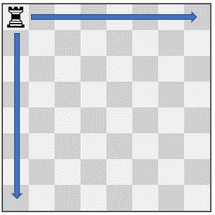
输入:pieces = ["rook"], positions = [[1,1]]
输出:15
解释:上图展示了棋子所有可能的移动。
示例 2:
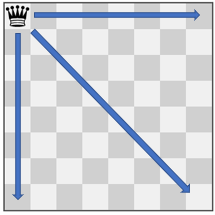
输入:pieces = ["queen"], positions = [[1,1]]
输出:22
解释:上图展示了棋子所有可能的移动。
示例 3:
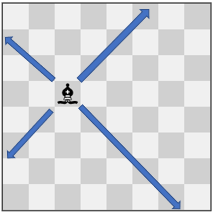
输入:pieces = ["bishop"], positions = [[4,3]]
输出:12
解释:上图展示了棋子所有可能的移动。
示例 4:
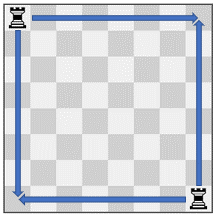
输入:pieces = ["rook","rook"], positions = [[1,1],[8,8]]
输出:223
解释:每个车有 15 种移动,所以总共有 15 * 15 = 225 种移动组合。
但是,有两个是不有效的移动组合:
- 将两个车都移动到 (8, 1) ,会导致它们在同一个格子相遇。
- 将两个车都移动到 (1, 8) ,会导致它们在同一个格子相遇。
所以,总共有 225 - 2 = 223 种有效移动组合。
注意,有两种有效的移动组合,分别是一个车在 (1, 8) ,另一个车在 (8, 1) 。
即使棋盘状态是相同的,这两个移动组合被视为不同的,因为每个棋子移动操作是不相同的。
示例 5:
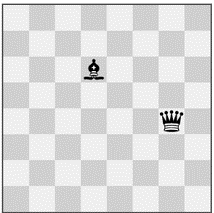
输入:pieces = ["queen","bishop"], positions = [[5,7],[3,4]]
输出:281
解释:总共有 12 * 24 = 288 种移动组合。
但是,有一些不有效的移动组合:
- 如果后停在 (6, 7) ,它会阻挡象到达 (6, 7) 或者 (7, 8) 。
- 如果后停在 (5, 6) ,它会阻挡象到达 (5, 6) ,(6, 7) 或者 (7, 8) 。
- 如果象停在 (5, 2) ,它会阻挡后到达 (5, 2) 或者 (5, 1) 。
在 288 个移动组合当中,281 个是有效的。
提示:
n == pieces.lengthn == positions.length1 <= n <= 4pieces只包含字符串"rook","queen"和"bishop"。- 棋盘上最多只有一个后。
1 <= ri, ci <= 8- 每一个
positions[i]互不相同。
解题思路
方法一:DFS
题目最多只有 个棋子,每个棋子的移动方向最多有 种,我们可以考虑使用 DFS 搜索所有的移动组合。
我们按照顺序依次枚举每个棋子,对于每个棋子,我们可以选择不移动,或者按照规则移动,用数组 记录第 个棋子的移动情况,其中 表示第 个棋子经过坐标 时的时间,用数组 记录第 个棋子的终点坐标和时间。在搜索时,我们需要分别判断当前棋子是否可以停止移动,以及当前棋子是否可以继续在当前方向移动。
我们定义方法 判断第 个棋子是否在时间 时停在坐标 ,如果对于此前的所有棋子 ,都有 ,那么第 个棋子可以停止移动。
另外,我们定义方法 判断第 个棋子是否可以在时间 时经过坐标 。如果此前有其它棋子 也在时间 经过坐标 ,或者有其它棋子 停在 ,且时间不超过 ,那么第 个棋子不能在时间 时经过坐标 。
时间复杂度 ,空间复杂度 。其中 是棋子的数量,而 是每个棋子的移动范围。
rook_dirs = [(1, 0), (-1, 0), (0, 1), (0, -1)]
bishop_dirs = [(1, 1), (1, -1), (-1, 1), (-1, -1)]
queue_dirs = rook_dirs + bishop_dirs


def get_dirs(piece: str) -> List[Tuple[int, int]]:
    match piece[0]:
        case "r":
            return rook_dirs
        case "b":
            return bishop_dirs
        case _:
            return queue_dirs


class Solution:
    def countCombinations(self, pieces: List[str], positions: List[List[int]]) -> int:
        def check_stop(i: int, x: int, y: int, t: int) -> bool:
            return all(dist[j][x][y] < t for j in range(i))

        def check_pass(i: int, x: int, y: int, t: int) -> bool:
            for j in range(i):
                if dist[j][x][y] == t:
                    return False
                if end[j][0] == x and end[j][1] == y and end[j][2] <= t:
                    return False
            return True

        def dfs(i: int) -> None:
            if i >= n:
                nonlocal ans
                ans += 1
                return
            x, y = positions[i]
            dist[i][:] = [[-1] * m for _ in range(m)]
            dist[i][x][y] = 0
            end[i] = (x, y, 0)
            if check_stop(i, x, y, 0):
                dfs(i + 1)
            dirs = get_dirs(pieces[i])
            for dx, dy in dirs:
                dist[i][:] = [[-1] * m for _ in range(m)]
                dist[i][x][y] = 0
                nx, ny, nt = x + dx, y + dy, 1
                while 1 <= nx < m and 1 <= ny < m and check_pass(i, nx, ny, nt):
                    dist[i][nx][ny] = nt
                    end[i] = (nx, ny, nt)
                    if check_stop(i, nx, ny, nt):
                        dfs(i + 1)
                    nx += dx
                    ny += dy
                    nt += 1

        n = len(pieces)
        m = 9
        dist = [[[-1] * m for _ in range(m)] for _ in range(n)]
        end = [(0, 0, 0) for _ in range(n)]
        ans = 0
        dfs(0)
        return ans
复杂度分析
| 指标 | 值 |
|---|---|
| 时间 | Depends on the final approach |
| 空间 | Depends on the final approach |
面试官常问的追问
外企场景- question_mark
The candidate demonstrates an understanding of backtracking and pruning techniques.
- question_mark
The candidate is able to efficiently simulate different chess piece moves and apply constraints to avoid overlap.
- question_mark
The candidate shows how to combine results from different pieces and compute the total number of valid combinations.
常见陷阱
外企场景- error
Forgetting to prune invalid paths early, leading to unnecessary calculations.
- error
Overcomplicating the solution by not taking advantage of the small input size (n <= 4).
- error
Failing to properly handle the unique movement rules for each type of piece (rook, bishop, queen).
进阶变体
外企场景- arrow_right_alt
Increasing the number of pieces to test how the solution scales.
- arrow_right_alt
Introducing more complex pieces with additional movement rules.
- arrow_right_alt
Adding time constraints to make the solution more efficient in a real-time chess simulation.