

LeetCode 题解工作台
可以到达每一个节点的最少边反转次数
给你一个 n 个点的 简单有向图 (没有重复边的有向图),节点编号为 0 到 n - 1 。如果这些边是双向边,那么这个图形成一棵 树 。 给你一个整数 n 和一个 二维 整数数组 edges ,其中 edges[i] = [u i , v i ] 表示从节点 u i 到节点 v i 有一条 有向边…
4
题型
5
代码语言
3
相关题
当前训练重点
困难 · 图·DFS·traversal
答案摘要
时间复杂度 ,空间复杂度 。 class Solution:


Interview AiBoxInterview AiBox 实时 AI 助手,陪你讲清 图·DFS·traversal 题型思路
题目描述
给你一个 n 个点的 简单有向图 (没有重复边的有向图),节点编号为 0 到 n - 1 。如果这些边是双向边,那么这个图形成一棵 树 。
给你一个整数 n 和一个 二维 整数数组 edges ,其中 edges[i] = [ui, vi] 表示从节点 ui 到节点 vi 有一条 有向边 。
边反转 指的是将一条边的方向反转,也就是说一条从节点 ui 到节点 vi 的边会变为一条从节点 vi 到节点 ui 的边。
对于范围 [0, n - 1] 中的每一个节点 i ,你的任务是分别 独立 计算 最少 需要多少次 边反转 ,从节点 i 出发经过 一系列有向边 ,可以到达所有的节点。
请你返回一个长度为 n 的整数数组 answer ,其中 answer[i]表示从节点 i 出发,可以到达所有节点的 最少边反转 次数。
示例 1:
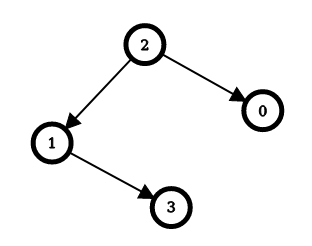
输入:n = 4, edges = [[2,0],[2,1],[1,3]]
输出:[1,1,0,2]
解释:上图表示了与输入对应的简单有向图。
对于节点 0 :反转 [2,0] ,从节点 0 出发可以到达所有节点。
所以 answer[0] = 1 。
对于节点 1 :反转 [2,1] ,从节点 1 出发可以到达所有节点。
所以 answer[1] = 1 。
对于节点 2 :不需要反转就可以从节点 2 出发到达所有节点。
所以 answer[2] = 0 。
对于节点 3 :反转 [1,3] 和 [2,1] ,从节点 3 出发可以到达所有节点。
所以 answer[3] = 2 。
示例 2:
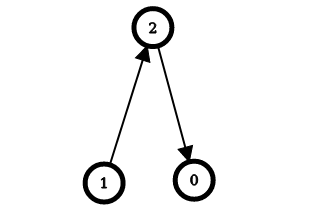
输入:n = 3, edges = [[1,2],[2,0]]
输出:[2,0,1]
解释:上图表示了与输入对应的简单有向图。
对于节点 0 :反转 [2,0] 和 [1,2] ,从节点 0 出发可以到达所有节点。
所以 answer[0] = 2 。
对于节点 1 :不需要反转就可以从节点 2 出发到达所有节点。
所以 answer[1] = 0 。
对于节点 2 :反转 [1,2] ,从节点 2 出发可以到达所有节点。
所以 answer[2] = 1 。
提示:
2 <= n <= 105edges.length == n - 1edges[i].length == 20 <= ui == edges[i][0] < n0 <= vi == edges[i][1] < nui != vi- 输入保证如果边是双向边,可以得到一棵树。
解题思路
方法一:树形 DP
时间复杂度 ,空间复杂度 。
class Solution:
    def minEdgeReversals(self, n: int, edges: List[List[int]]) -> List[int]:
        ans = [0] * n
        g = [[] for _ in range(n)]
        for x, y in edges:
            g[x].append((y, 1))
            g[y].append((x, -1))

        def dfs(i: int, fa: int):
            for j, k in g[i]:
                if j != fa:
                    ans[0] += int(k < 0)
                    dfs(j, i)

        dfs(0, -1)

        def dfs2(i: int, fa: int):
            for j, k in g[i]:
                if j != fa:
                    ans[j] = ans[i] + k
                    dfs2(j, i)

        dfs2(0, -1)
        return ans
复杂度分析
| 指标 | 值 |
|---|---|
| 时间 | Depends on the final approach |
| 空间 | Depends on the final approach |
面试官常问的追问
外企场景- question_mark
Candidates should demonstrate an understanding of graph traversal techniques, especially DFS and BFS.
- question_mark
Look for candidates who can break down the problem into manageable subproblems, particularly using dynamic programming on trees.
- question_mark
Watch for efficient solutions that scale well, given the problem's constraints of up to 10^5 nodes.
常见陷阱
外企场景- error
Failing to handle cases where reversing an edge is necessary for connectivity between nodes.
- error
Overcomplicating the problem by using more complex algorithms than necessary for tree-based graphs.
- error
Not considering the optimal way to track and minimize edge reversals during DFS traversal.
进阶变体
外企场景- arrow_right_alt
What if the graph were not a tree, but still had some cycles? How would this affect the approach?
- arrow_right_alt
How would the solution change if the edges could be reversed multiple times, rather than just once?
- arrow_right_alt
What happens if the graph is initially a fully connected directed graph? Can the solution be simplified?