

LeetCode 题解工作台
经营摩天轮的最大利润
你正在经营一座摩天轮,该摩天轮共有 4 个座舱 ,每个座舱 最多可以容纳 4 位游客 。你可以 逆时针 轮转座舱,但每次轮转都需要支付一定的运行成本 runningCost 。 给你一个长度为 n 的数组 customers , customers[i] 是在第 i 次轮转(下标从 0 开始)之前到…
2
题型
6
代码语言
3
相关题
当前训练重点
中等 · 数组·模拟
答案摘要
我们直接模拟摩天轮的轮转过程,每次轮转时,累加等待的游客以及新到达的游客,然后最多 个人上船,更新等待的游客数和利润,记录最大利润与其对应的轮转次数。 时间复杂度 ,其中 为数组 `customers` 的长度。空间复杂度 。


Interview AiBoxInterview AiBox 实时 AI 助手,陪你讲清 数组·模拟 题型思路
题目描述
你正在经营一座摩天轮,该摩天轮共有 4 个座舱 ,每个座舱 最多可以容纳 4 位游客 。你可以 逆时针 轮转座舱,但每次轮转都需要支付一定的运行成本 runningCost 。
给你一个长度为 n 的数组 customers , customers[i] 是在第 i 次轮转(下标从 0 开始)之前到达的新游客的数量。这也意味着你必须在新游客到来前轮转 i 次。如果有座舱空闲就不能让游客等待。每位游客在登上离地面最近的座舱前都会支付登舱成本 boardingCost ,一旦该座舱再次抵达地面,他们就会离开座舱结束游玩。
你可以随时停下摩天轮,即便是 在服务所有游客之前 。如果你决定停止运营摩天轮,为了保证所有游客安全着陆,将免费进行所有后续轮转 。注意,如果有超过 4 位游客在等摩天轮,那么只有 4 位游客可以登上摩天轮,其余的需要等待 下一次轮转 。
返回最大化利润所需执行的 最小轮转次数 。 如果不存在利润为正的方案,则返回 -1 。
示例 1:
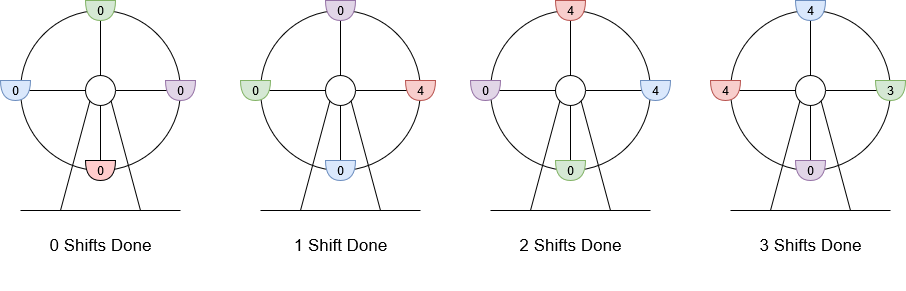
输入:customers = [8,3], boardingCost = 5, runningCost = 6
输出:3
解释:座舱上标注的数字是该座舱的当前游客数。
1. 8 位游客抵达,4 位登舱,4 位等待下一舱,摩天轮轮转。当前利润为 4 * $5 - 1 * $6 = $14 。
2. 3 位游客抵达,4 位在等待的游客登舱,其他 3 位等待,摩天轮轮转。当前利润为 8 * $5 - 2 * $6 = $28 。
3. 最后 3 位游客登舱,摩天轮轮转。当前利润为 11 * $5 - 3 * $6 = $37 。
轮转 3 次得到最大利润,最大利润为 $37 。
示例 2:
输入:customers = [10,9,6], boardingCost = 6, runningCost = 4
输出:7
解释:
1. 10 位游客抵达,4 位登舱,6 位等待下一舱,摩天轮轮转。当前利润为 4 * $6 - 1 * $4 = $20 。
2. 9 位游客抵达,4 位登舱,11 位等待(2 位是先前就在等待的,9 位新加入等待的),摩天轮轮转。当前利润为 8 * $6 - 2 * $4 = $40 。
3. 最后 6 位游客抵达,4 位登舱,13 位等待,摩天轮轮转。当前利润为 12 * $6 - 3 * $4 = $60 。
4. 4 位登舱,9 位等待,摩天轮轮转。当前利润为 * $6 - 4 * $4 = $80 。
5. 4 位登舱,5 位等待,摩天轮轮转。当前利润为 20 * $6 - 5 * $4 = $100 。
6. 4 位登舱,1 位等待,摩天轮轮转。当前利润为 24 * $6 - 6 * $4 = $120 。
7. 1 位登舱,摩天轮轮转。当前利润为 25 * $6 - 7 * $4 = $122 。
轮转 7 次得到最大利润,最大利润为$122 。
示例 3:
输入:customers = [3,4,0,5,1], boardingCost = 1, runningCost = 92
输出:-1
解释:
1. 3 位游客抵达,3 位登舱,0 位等待,摩天轮轮转。当前利润为 3 * $1 - 1 * $92 = -$89 。
2. 4 位游客抵达,4 位登舱,0 位等待,摩天轮轮转。当前利润为 7 * $1 - 2 * $92 = -$177 。
3. 0 位游客抵达,0 位登舱,0 位等待,摩天轮轮转。当前利润为 7 * $1 - 3 * $92 = -$269 。
4. 5 位游客抵达,4 位登舱,1 位等待,摩天轮轮转。当前利润为 11 * $1 - 4 * $92 = -$357 。
5. 1 位游客抵达,2 位登舱,0 位等待,摩天轮轮转。当前利润为 13 * $1 - 5 * $92 = -$447 。
利润永不为正,所以返回 -1 。
提示:
n == customers.length1 <= n <= 1050 <= customers[i] <= 501 <= boardingCost, runningCost <= 100
解题思路
方法一:模拟
我们直接模拟摩天轮的轮转过程,每次轮转时,累加等待的游客以及新到达的游客,然后最多 个人上船,更新等待的游客数和利润,记录最大利润与其对应的轮转次数。
时间复杂度 ,其中 为数组 customers 的长度。空间复杂度 。
class Solution:
    def minOperationsMaxProfit(
        self, customers: List[int], boardingCost: int, runningCost: int
    ) -> int:
        ans = -1
        mx = t = 0
        wait = 0
        i = 0
        while wait or i < len(customers):
            wait += customers[i] if i < len(customers) else 0
            up = wait if wait < 4 else 4
            wait -= up
            t += up * boardingCost - runningCost
            i += 1
            if t > mx:
                mx = t
                ans = i
        return ans
复杂度分析
| 指标 | 值 |
|---|---|
| 时间 | Depends on the final approach |
| 空间 | Depends on the final approach |
面试官常问的追问
外企场景- question_mark
Candidate understands how to simulate the boarding process and calculate profits.
- question_mark
The candidate demonstrates the ability to handle dynamic adjustments in customer flow and gondola capacity.
- question_mark
The candidate successfully identifies the optimal stopping point to maximize profit.
常见陷阱
外企场景- error
Overcomplicating the calculation of profit by not directly tracking revenue and cost per rotation.
- error
Failing to consider the gondola capacity limit when customers exceed the number waiting to board.
- error
Not accounting for the scenario where no positive profit can be made, and returning -1.
进阶变体
外企场景- arrow_right_alt
Modify the problem by introducing different gondola capacities for different rotations.
- arrow_right_alt
Add a restriction that requires a certain number of customers to always board the wheel, regardless of the gondola space.
- arrow_right_alt
Simulate the problem under different customer behavior models, such as customers leaving after a certain number of rotations.