

LeetCode 题解工作台
规划兼职工作
你打算利用空闲时间来做兼职工作赚些零花钱。 这里有 n 份兼职工作,每份工作预计从 startTime[i] 开始到 endTime[i] 结束,报酬为 profit[i] 。 给你一份兼职工作表,包含开始时间 startTime ,结束时间 endTime 和预计报酬 profit 三个数组,请你…
4
题型
6
代码语言
3
相关题
当前训练重点
困难 · 状态·转移·动态规划
答案摘要
我们先将工作按照开始时间从小到大排序,然后设计一个函数 表示从第 份工作开始,可以获得的最大报酬。答案即为 。 函数 的计算过程如下:


Interview AiBoxInterview AiBox 实时 AI 助手,陪你讲清 状态·转移·动态规划 题型思路
题目描述
你打算利用空闲时间来做兼职工作赚些零花钱。
这里有 n 份兼职工作,每份工作预计从 startTime[i] 开始到 endTime[i] 结束,报酬为 profit[i]。
给你一份兼职工作表,包含开始时间 startTime,结束时间 endTime 和预计报酬 profit 三个数组,请你计算并返回可以获得的最大报酬。
注意,时间上出现重叠的 2 份工作不能同时进行。
如果你选择的工作在时间 X 结束,那么你可以立刻进行在时间 X 开始的下一份工作。
示例 1:
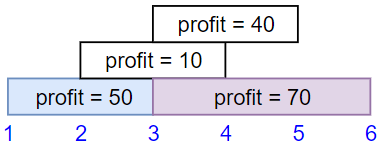
输入:startTime = [1,2,3,3], endTime = [3,4,5,6], profit = [50,10,40,70]
输出:120
解释:
我们选出第 1 份和第 4 份工作,
时间范围是 [1-3]+[3-6],共获得报酬 120 = 50 + 70。
示例 2:
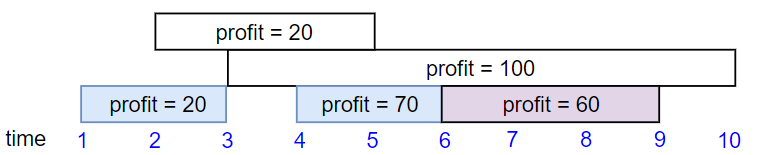
输入:startTime = [1,2,3,4,6], endTime = [3,5,10,6,9], profit = [20,20,100,70,60]
输出:150
解释:
我们选择第 1,4,5 份工作。
共获得报酬 150 = 20 + 70 + 60。
示例 3:
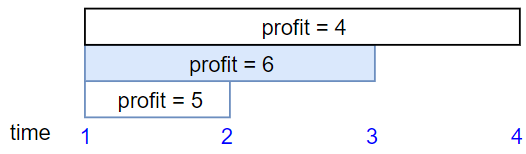
输入:startTime = [1,1,1], endTime = [2,3,4], profit = [5,6,4]
输出:6
提示:
1 <= startTime.length == endTime.length == profit.length <= 5 * 10^41 <= startTime[i] < endTime[i] <= 10^91 <= profit[i] <= 10^4
解题思路
方法一:记忆化搜索 + 二分查找
我们先将工作按照开始时间从小到大排序,然后设计一个函数 表示从第 份工作开始,可以获得的最大报酬。答案即为 。
函数 的计算过程如下:
对于第 份工作,我们可以选择做,也可以选择不做。如果不做,最大报酬就是 ;如果做,我们可以通过二分查找,找到在第 份工作结束时间之后开始的第一份工作,记为 ,那么最大报酬就是 。取两者的较大值即可。即:
其中 是满足 的最小的下标。
此过程中,我们可以使用记忆化搜索,将每个状态的答案保存下来,避免重复计算。
时间复杂度 ,其中 是工作的数量。
class Solution:
    def jobScheduling(
        self, startTime: List[int], endTime: List[int], profit: List[int]
    ) -> int:
        @cache
        def dfs(i):
            if i >= n:
                return 0
            _, e, p = jobs[i]
            j = bisect_left(jobs, e, lo=i + 1, key=lambda x: x[0])
            return max(dfs(i + 1), p + dfs(j))

        jobs = sorted(zip(startTime, endTime, profit))
        n = len(profit)
        return dfs(0)
复杂度分析
| 指标 | 值 |
|---|---|
| 时间 | complexity is O(n log n) due to sorting and binary search for each job. Space complexity is O(n) for storing DP states and the combined job list. |
| 空间 | Depends on the final approach |
面试官常问的追问
外企场景- question_mark
Expect sorting by end times before DP.
- question_mark
Look for correct DP state definition to store maximum profit up to each job.
- question_mark
Binary search for previous compatible job is crucial for efficiency.
常见陷阱
外企场景- error
Forgetting that a job ending at X can allow a new job starting at X.
- error
Performing linear search instead of binary search, increasing runtime.
- error
Incorrectly updating DP array, not considering the maximum between including or skipping a job.
进阶变体
外企场景- arrow_right_alt
Allow jobs with equal start and end times and handle them in DP updates.
- arrow_right_alt
Find the maximum number of jobs instead of profit using a similar DP approach.
- arrow_right_alt
Add a constraint on maximum total duration and adapt the DP to track both profit and duration.