

LeetCode 题解工作台
矩阵的最大非负积
给你一个大小为 m x n 的矩阵 grid 。最初,你位于左上角 (0, 0) ,每一步,你可以在矩阵中 向右 或 向下 移动。 在从左上角 (0, 0) 开始到右下角 (m - 1, n - 1) 结束的所有路径中,找出具有 最大非负积 的路径。路径的积是沿路径访问的单元格中所有整数的乘积。 返…
3
题型
6
代码语言
3
相关题
当前训练重点
中等 · 状态·转移·动态规划
答案摘要
我们定义一个三维数组 ,其中 和 分别表示从左上角 $(0, 0)$ 出发到达位置 $(i, j)$ 的路径中积的最小值和最大值。对于每个位置 $(i, j)$,我们可以从上方 $(i - 1, j)$ 或左方 $(i, j - 1)$ 转移过来,因此我们需要考虑这两条路径的积的最小值和最大值与当前单元格的值相乘后的结果。 最后,我们需要返回 $f[m - 1][n - 1][1]$ 对 $1…


Interview AiBoxInterview AiBox 实时 AI 助手,陪你讲清 状态·转移·动态规划 题型思路
题目描述
给你一个大小为 m x n 的矩阵 grid 。最初,你位于左上角 (0, 0) ,每一步,你可以在矩阵中 向右 或 向下 移动。
在从左上角 (0, 0) 开始到右下角 (m - 1, n - 1) 结束的所有路径中,找出具有 最大非负积 的路径。路径的积是沿路径访问的单元格中所有整数的乘积。
返回 最大非负积 对 109 + 7 取余 的结果。如果最大积为 负数 ,则返回 -1 。
注意,取余是在得到最大积之后执行的。
示例 1:
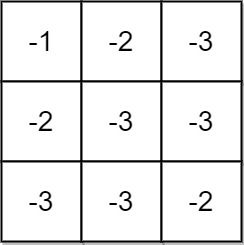
输入:grid = [[-1,-2,-3],[-2,-3,-3],[-3,-3,-2]]
输出:-1
解释:从 (0, 0) 到 (2, 2) 的路径中无法得到非负积,所以返回 -1 。
示例 2:
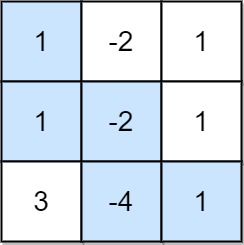
输入:grid = [[1,-2,1],[1,-2,1],[3,-4,1]]
输出:8
解释:最大非负积对应的路径如图所示 (1 * 1 * -2 * -4 * 1 = 8)
示例 3:
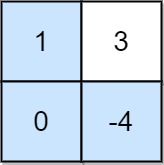
输入:grid = [[1,3],[0,-4]]
输出:0
解释:最大非负积对应的路径如图所示 (1 * 0 * -4 = 0)
提示:
m == grid.lengthn == grid[i].length1 <= m, n <= 15-4 <= grid[i][j] <= 4
解题思路
方法一:动态规划
我们定义一个三维数组 ,其中 和 分别表示从左上角 出发到达位置 的路径中积的最小值和最大值。对于每个位置 ,我们可以从上方 或左方 转移过来,因此我们需要考虑这两条路径的积的最小值和最大值与当前单元格的值相乘后的结果。
最后,我们需要返回 对 取余的结果,如果 小于 ,则返回 。
时间复杂度 ,空间复杂度 。其中 和 分别是矩阵的行数和列数。
class Solution:
    def maxProductPath(self, grid: List[List[int]]) -> int:
        m, n = len(grid), len(grid[0])
        f = [[[0, 0] for _ in range(n)] for _ in range(m)]

        for i in range(m):
            for j in range(n):
                x = grid[i][j]
                if i == 0 and j == 0:
                    f[i][j][0] = x
                    f[i][j][1] = x
                    continue

                mn, mx = inf, -inf

                if i > 0:
                    a, b = f[i - 1][j]
                    mn = min(mn, a * x, b * x)
                    mx = max(mx, a * x, b * x)

                if j > 0:
                    a, b = f[i][j - 1]
                    mn = min(mn, a * x, b * x)
                    mx = max(mx, a * x, b * x)

                f[i][j][0], f[i][j][1] = mn, mx

        ans = f[m - 1][n - 1][1]
        mod = 10**9 + 7
        return -1 if ans < 0 else ans % mod
复杂度分析
| 指标 | 值 |
|---|---|
| 时间 | Depends on the final approach |
| 空间 | Depends on the final approach |
面试官常问的追问
外企场景- question_mark
Candidate's understanding of state transition dynamic programming should be evident in how they handle both maximum and minimum products.
- question_mark
They should be able to explain why maintaining both max and min products is crucial in the context of negative numbers.
- question_mark
Look for clarity in explaining how modulo operations are applied and how it affects large results.
常见陷阱
外企场景- error
Failing to account for negative numbers and their effect on the product, which may lead to incorrect results.
- error
Not handling the modulo operation correctly, leading to overflow or incorrect final results.
- error
Incorrectly assuming that all paths will have non-negative products, leading to incorrect edge case handling.
进阶变体
外企场景- arrow_right_alt
Consider using this approach for similar grid-based dynamic programming problems with path constraints.
- arrow_right_alt
Variant could involve adding diagonal movement, requiring an additional transition step.
- arrow_right_alt
Extend this to 3D grids, where moves can be made in three dimensions instead of two.