

LeetCode 题解工作台
乘法表中第k小的数
几乎每一个人都用 乘法表 。但是你能在乘法表中快速找到第 k 小的数字吗? 乘法表是大小为 m x n 的一个整数矩阵,其中 mat[i][j] == i * j (下标从 1 开始)。 给你三个整数 m 、 n 和 k ,请你在大小为 m x n 的乘法表中,找出并返回第 k 小的数字。 示例 1…
2
题型
4
代码语言
3
相关题
当前训练重点
困难 · 二分·搜索·答案·空间
答案摘要
题目可以转换为,求有多少个数不超过 x。对于每一行 i,所有数都是 i 的倍数,不超过 x 的个数有 `x / i` 个。 二分枚举 x,累加每一行不超过 x 的个数,得到 cnt。找到 `cnt >= k` 的最小 x。


Interview AiBoxInterview AiBox 实时 AI 助手,陪你讲清 二分·搜索·答案·空间 题型思路
题目描述
几乎每一个人都用 乘法表。但是你能在乘法表中快速找到第 k 小的数字吗?
乘法表是大小为 m x n 的一个整数矩阵,其中 mat[i][j] == i * j(下标从 1 开始)。
给你三个整数 m、n 和 k,请你在大小为 m x n 的乘法表中,找出并返回第 k 小的数字。
示例 1:
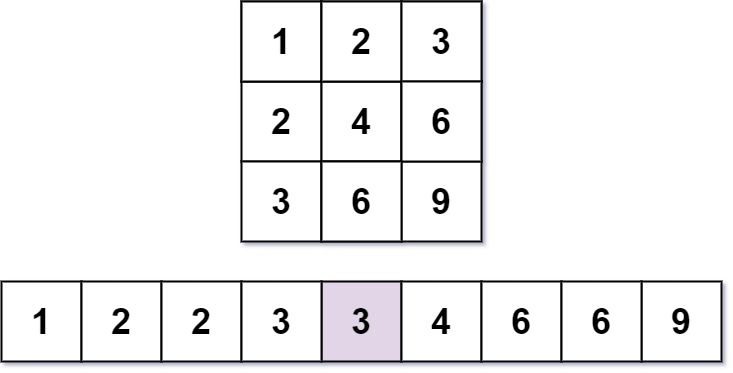
输入:m = 3, n = 3, k = 5
输出:3
解释:第 5 小的数字是 3 。
示例 2:
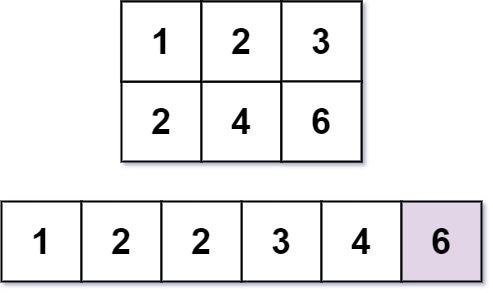
输入:m = 2, n = 3, k = 6
输出:6
解释:第 6 小的数字是 6 。
提示:
1 <= m, n <= 3 * 1041 <= k <= m * n
解题思路
方法一:二分查找
题目可以转换为,求有多少个数不超过 x。对于每一行 i,所有数都是 i 的倍数,不超过 x 的个数有 x / i 个。
二分枚举 x,累加每一行不超过 x 的个数,得到 cnt。找到 cnt >= k 的最小 x。
class Solution:
    def findKthNumber(self, m: int, n: int, k: int) -> int:
        left, right = 1, m * n
        while left < right:
            mid = (left + right) >> 1
            cnt = 0
            for i in range(1, m + 1):
                cnt += min(mid // i, n)
            if cnt >= k:
                right = mid
            else:
                left = mid + 1
        return left
复杂度分析
| 指标 | 值 |
|---|---|
| 时间 | O(m * \log (m*n)) |
| 空间 | O(1) |
面试官常问的追问
外企场景- question_mark
The candidate should focus on utilizing binary search over the answer space effectively.
- question_mark
Expect the candidate to leverage the properties of the multiplication table to count elements efficiently in each row.
- question_mark
Look for an understanding of how to minimize unnecessary calculations through early termination or efficient counting.
常见陷阱
外企场景- error
A common mistake is performing a brute force search, where the candidate tries to generate the entire multiplication table to find the kth smallest number. This approach is inefficient and fails for large inputs.
- error
Misunderstanding how to count elements less than or equal to a mid value in each row of the multiplication table can lead to incorrect results or inefficient solutions.
- error
Candidates may miss the optimal space complexity, leading to an unnecessarily large space usage.
进阶变体
外企场景- arrow_right_alt
What if the multiplication table is much larger? How would the solution scale with larger m and n?
- arrow_right_alt
Can the problem be solved without using binary search? If so, what trade-offs would be involved?
- arrow_right_alt
How can this approach be applied if the table is not sorted or if the rows and columns are not strictly increasing?