

LeetCode 题解工作台
合并两棵树后的最小直径
给你两棵 无向 树,分别有 n 和 m 个节点,节点编号分别为 0 到 n - 1 和 0 到 m - 1 。给你两个二维整数数组 edges1 和 edges2 ,长度分别为 n - 1 和 m - 1 ,其中 edges1[i] = [a i , b i ] 表示在第一棵树中节点 a i 和 b…
4
题型
7
代码语言
3
相关题
当前训练重点
困难 · 图·DFS·traversal
答案摘要
我们记 和 分别为两棵树的直径,那么合并后的树的直径有以下两种情况: 1. 合并后的树的直径为原始的一棵树的直径,即 $\max(d_1, d_2)$;


Interview AiBoxInterview AiBox 实时 AI 助手,陪你讲清 图·DFS·traversal 题型思路
题目描述
给你两棵 无向 树,分别有 n 和 m 个节点,节点编号分别为 0 到 n - 1 和 0 到 m - 1 。给你两个二维整数数组 edges1 和 edges2 ,长度分别为 n - 1 和 m - 1 ,其中 edges1[i] = [ai, bi] 表示在第一棵树中节点 ai 和 bi 之间有一条边,edges2[i] = [ui, vi] 表示在第二棵树中节点 ui 和 vi 之间有一条边。
你必须在第一棵树和第二棵树中分别选一个节点,并用一条边连接它们。
请你返回添加边后得到的树中,最小直径 为多少。
一棵树的 直径 指的是树中任意两个节点之间的最长路径长度。
示例 1: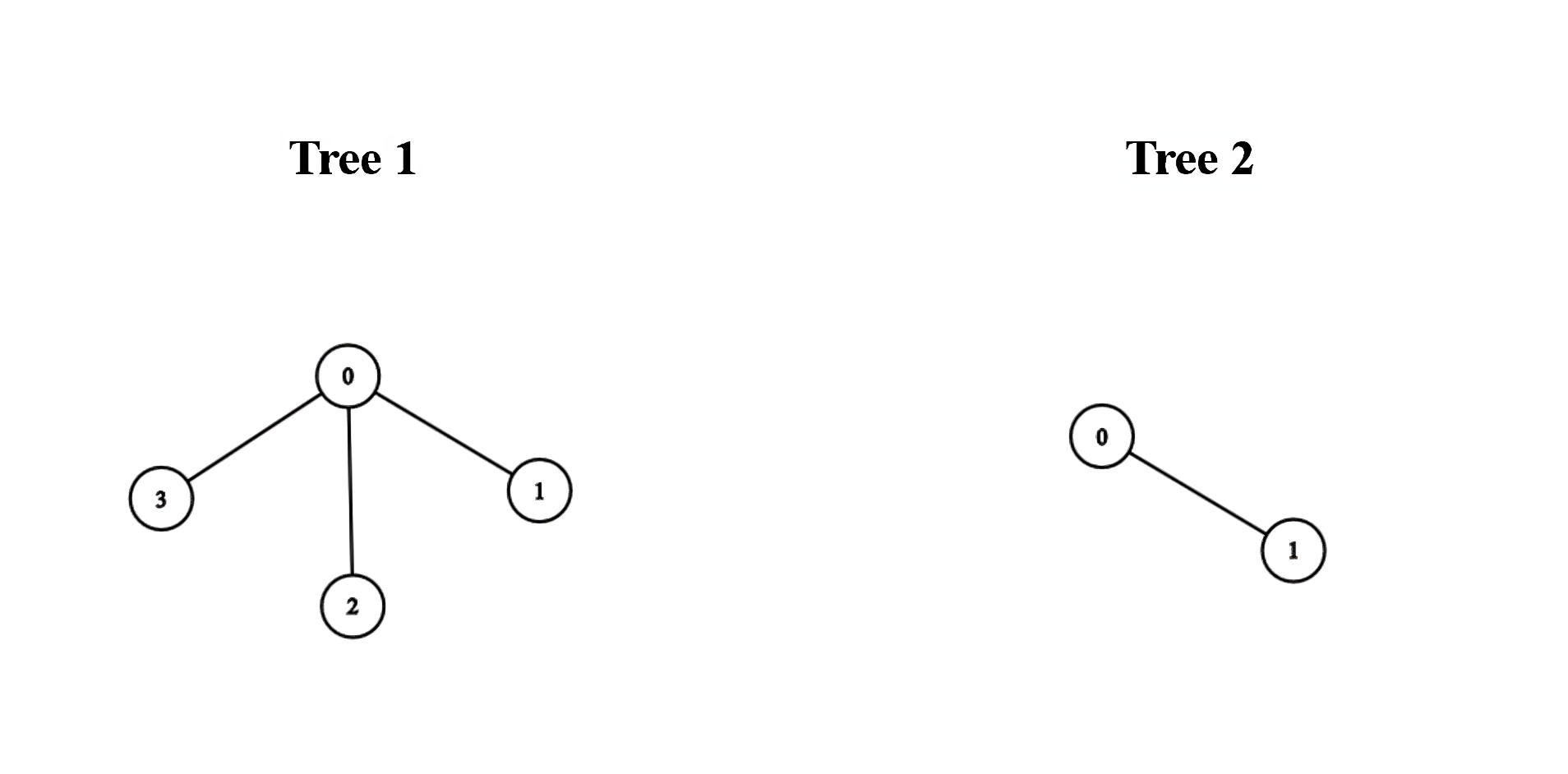
输入:edges1 = [[0,1],[0,2],[0,3]], edges2 = [[0,1]]
输出:3
解释:
将第一棵树中的节点 0 与第二棵树中的任意节点连接,得到一棵直径为 3 的树。
示例 2: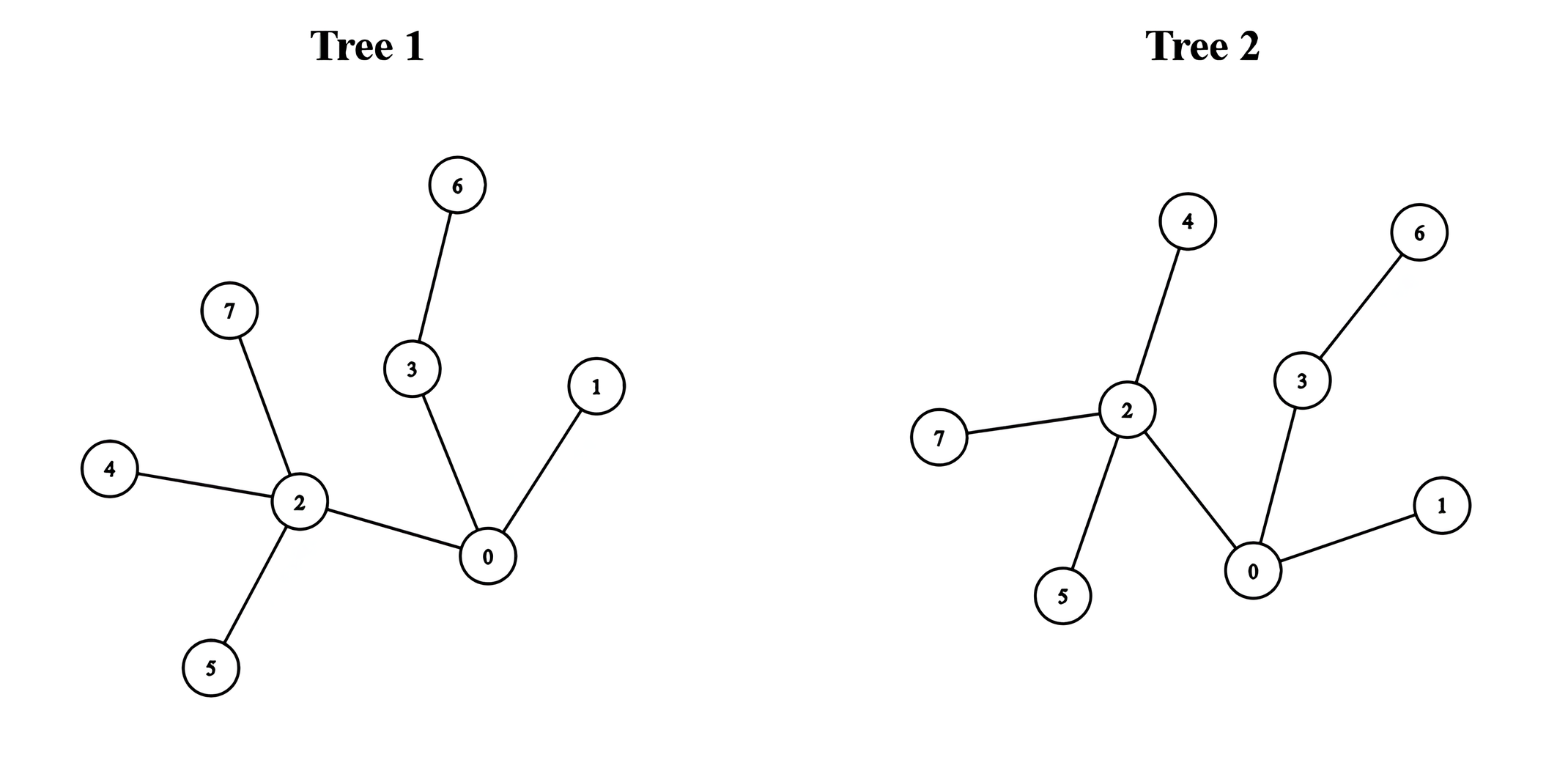
输入:edges1 = [[0,1],[0,2],[0,3],[2,4],[2,5],[3,6],[2,7]], edges2 = [[0,1],[0,2],[0,3],[2,4],[2,5],[3,6],[2,7]]
输出:5
解释:
将第一棵树中的节点 0 和第二棵树中的节点 0 连接,可以得到一棵直径为 5 的树。
提示:
1 <= n, m <= 105edges1.length == n - 1edges2.length == m - 1edges1[i].length == edges2[i].length == 2edges1[i] = [ai, bi]0 <= ai, bi < nedges2[i] = [ui, vi]0 <= ui, vi < m- 输入保证
edges1和edges2分别表示一棵合法的树。
解题思路
方法一:两次 DFS
我们记 和 分别为两棵树的直径,那么合并后的树的直径有以下两种情况:
- 合并后的树的直径为原始的一棵树的直径,即 ;
- 合并后的树的直径经过原始的两棵树。我们分别计算原始的两棵树的半径 和 ,那么合并后的树的直径为 。
我们取这两种情况的最大值即可。
在计算树的直径时,我们可以使用两次 DFS。首先我们任选一点出发,找到距离该点最远的点,记为 。然后从点 出发,找到距离点 最远的点,记为 。可以证明,点 和点 之间的路径即为树的直径。
时间复杂度 ,空间复杂度 。其中 和 分别为两棵树的节点数。
class Solution:
    def minimumDiameterAfterMerge(
        self, edges1: List[List[int]], edges2: List[List[int]]
    ) -> int:
        d1 = self.treeDiameter(edges1)
        d2 = self.treeDiameter(edges2)
        return max(d1, d2, (d1 + 1) // 2 + (d2 + 1) // 2 + 1)

    def treeDiameter(self, edges: List[List[int]]) -> int:
        def dfs(i: int, fa: int, t: int):
            for j in g[i]:
                if j != fa:
                    dfs(j, i, t + 1)
            nonlocal ans, a
            if ans < t:
                ans = t
                a = i

        g = defaultdict(list)
        for a, b in edges:
            g[a].append(b)
            g[b].append(a)
        ans = a = 0
        dfs(0, -1, 0)
        dfs(a, -1, 0)
        return ans
复杂度分析
| 指标 | 值 |
|---|---|
| 时间 | complexity is O(n + m) because BFS or DFS traverses each node once in both trees. Space complexity is O(n + m) to store adjacency lists for each tree and recursive or queue storage during traversal. |
| 空间 | O(n + m) |
面试官常问的追问
外企场景- question_mark
Expect candidates to quickly identify diameter endpoints using BFS or DFS.
- question_mark
Watch for reasoning on how connecting nodes affects the combined tree's diameter.
- question_mark
Notice whether candidates correctly optimize the maximum path rather than connecting arbitrarily.
常见陷阱
外企场景- error
Choosing arbitrary nodes instead of endpoints can lead to non-minimal diameters.
- error
Neglecting the internal diameter of each tree before merging can miscalculate the final result.
- error
Forgetting to consider the longest path that passes through the connecting edge may produce incorrect outputs.
进阶变体
外企场景- arrow_right_alt
Compute minimum diameter when merging more than two trees sequentially.
- arrow_right_alt
Find the maximum diameter instead of minimum after connecting trees.
- arrow_right_alt
Apply the same logic to weighted trees where edges have lengths other than 1.